Create the perfect backyard party sound setup with our complete guide. Learn how to choose gear and position speakers for clear, balanced sound!
TL;DR:
• A backyard party sound setup requires weather-resistant speakers and proper placement to ensure balanced, clear sound. Using multiple speakers at moderate volumes and centered positioning prevents dead zones and minimizes neighbor noise complaints. Proper planning, testing, and zone control create a seamless outdoor audio experience.
A backyard party sound setup is the process of arranging outdoor audio equipment to deliver balanced, clear sound across your entire yard. Unlike indoor spaces, open-air environments absorb and scatter sound quickly, so the right gear and placement make all the difference. This guide covers the equipment you need, how to position speakers for full coverage, and how to test your system before guests arrive. Follow these steps and your outdoor party audio system will sound great from the patio to the back fence.
The foundation of any outdoor audio system is a set of weather-resistant speakers. IP65-rated speakers or higher are the standard for US backyards, protecting against rain, dust, and temperature swings. That rating is not a luxury. It is the minimum you need to avoid replacing equipment after one rainy season.
Your speaker options fall into two categories: powered speakers with built-in amplifiers, and passive speakers that require a separate amp. Powered speakers are easier to set up for a DIY sound system for parties. Passive speakers give you more control over amplification but require more wiring and planning.
Amplification matters more outdoors than most people expect. Outdoor venues lack reflective surfaces, so a gathering of about 30 people needs at least 500–1,000 watts of powered output to maintain clarity. That is two to three times the power you would need for the same crowd indoors.
Here is the core gear list for a complete backyard sound equipment setup:
• Weatherproof speakers (IP65 or higher, powered or passive)
• Amplifier or AV receiver matched to your yard size and speaker count
• Outdoor-rated speaker wire (direct-burial cable for permanent installs)
• Mounting hardware (wall brackets, speaker stands, or in-ground stakes)
• Power distribution strip or outdoor-rated extension cord (never daisy-chain standard indoor cords)
• Subwoofer (optional but recommended for music-heavy events)
• Bluetooth receiver or mixer for wireless source connection
Pro Tip: A 3–8 speaker setup spread across your yard at moderate volume beats two loud speakers in the corners every time. More speakers at lower volumes means better coverage and fewer complaints from neighbors.

Speaker placement is where most DIY backyard music setups go wrong. The most common mistake is pushing speakers to the corners or edges of the yard. Corner and edge placements create uneven reflections and dead zones in the middle of the space where most guests stand.
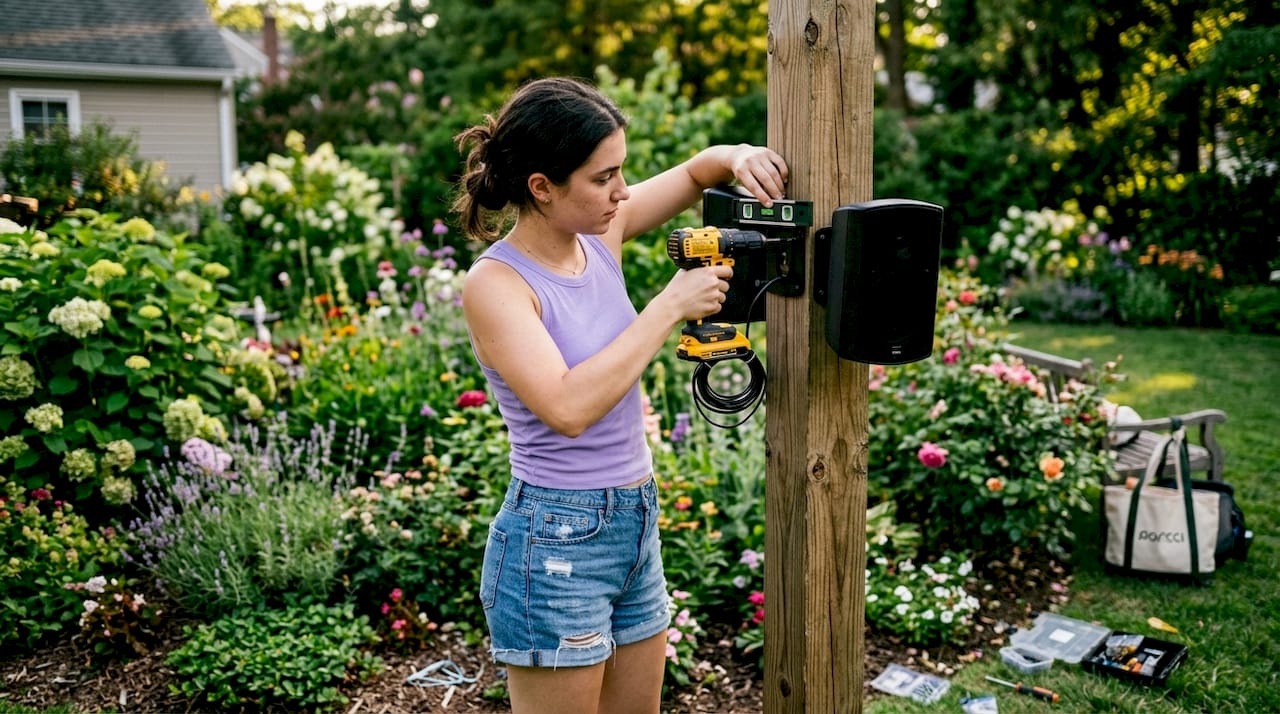
The fix is to position speakers toward the center of the yard and angle them outward toward the audience. Mount them 8–10 feet above ground so sound reaches listeners directly without obstruction. For larger yards, space speakers 8–12 feet apart. For tighter spaces, bring them closer together for a more cohesive sound field.
Follow these steps to plan your speaker layout:
1. Sketch your yard. Mark the patio, pool, grill area, and any trees or structures that block sound.
2. Identify your zones. Decide which areas need music and at what volume level.
3. Mark speaker positions. Aim for even spacing and center-weighted placement.
4. Plan cable runs. Route outdoor-rated wire away from foot traffic and water sources.
5. Note power outlet locations. Confirm you have enough circuits to avoid overloading.
Zone-based audio control is the most effective way to manage a multi-area backyard. It lets you run louder music near the dance area while keeping the conversation zone near the grill at a lower volume. That balance keeps guests comfortable and keeps the flow moving without audio overload.
Pro Tip: Dense shrubs and hedges along your property line act as natural sound barriers. Positioning speakers to face inward and using landscaping as a buffer reduces sound spill to neighbors significantly.
Setup goes smoothly when you work in a logical sequence. Rushing the installation leads to loose connections, feedback, and dead spots you only discover when guests arrive.
1. Run your cable first. Lay all speaker wire before mounting anything. Use outdoor-rated or direct-burial cable for any runs near soil or water.
2. Mount speakers at the correct height. Aim for 8–10 feet above ground, angled 10–15 degrees downward toward the listening area.
3. Connect speakers to your amplifier. Match impedance ratings (typically 4–8 ohms) to avoid overloading the amp.
4. Power up and set levels low. Start at 30% volume and increase gradually while walking the yard to check for dead spots.
5. Test with music, not tones. Play a track with a wide frequency range to hear how bass and treble perform in your space.
6. Adjust speaker angles. Small angle changes fix most dead zones without moving the entire mount.
| Setup step | Key detail |
|---|---|
| Cable routing | Use outdoor-rated wire; avoid indoor extension cords |
| Speaker height | 8–10 feet above ground for direct sound delivery |
| Amplifier power | 500–1,000 watts minimum for 30 guests outdoors |
| Volume testing | Walk the full yard at each volume level to find gaps |
| Power supply | Avoid daisy-chained cords; use proper distribution |
For Bluetooth setups, look for speakers that support party mode or Bluetooth Auracast to synchronize multiple units. Latency between unsynchronized Bluetooth speakers causes a noticeable echo effect that ruins the listening experience. Wired connections always deliver tighter sync for larger setups.
Outdoor sound setups face problems that indoor systems never encounter. Knowing what to expect lets you solve issues before they disrupt your event.
• Wind and ambient noise. Wind direction and temperature gradients affect sound propagation and perceived loudness. Conduct a site survey on a typical weather day to understand how sound carries in your specific yard.
• Bass loss. Outdoors, bass rolls off fast because there are no walls to reinforce low frequencies. Cluster subwoofers centrally to compensate for the lack of room coupling and recover low-end impact.
• Bluetooth echo. Multiple Bluetooth speakers that are not synchronized create latency gaps. Use a wired system or speakers with a built-in sync feature for larger setups.
• Power problems. Voltage sags from improper extension cord use damage equipment and cause signal dropouts. Run dedicated outdoor circuits or use a proper power distribution unit.
• Neighbor complaints. Multiple speakers at moderate volumes cover your yard better than one loud speaker. Keep individual speaker levels reasonable and use zone control to manage volume by area.
The single most overlooked step in any backyard audio setup is the pre-event sound walk. Walk every corner of your yard while music plays at party volume. Fix dead spots and hot spots before guests arrive, not after.
Pro Tip: Check your local noise ordinance before the event. Most residential areas in the US enforce quiet hours between 10:00 PM and 7:00 AM. Knowing the rules lets you plan your event timeline and volume levels with confidence.
A well-planned outdoor audio system uses multiple speakers at moderate volumes, weather-resistant gear, and zone-based control to deliver clear, consistent sound across every area of your backyard.
| Point | Details |
|---|---|
| Use IP65-rated speakers | Weather-resistant gear survives rain, dust, and temperature changes in US backyards. |
| Power up for outdoors | Aim for 500–1,000 watts for 30 guests; open air needs 2–3 times indoor power. |
| Center your speaker placement | Avoid corners and edges; center-weighted placement eliminates dead zones. |
| Build audio zones | Independent volume control per area matches music energy to each activity space. |
| Test before the event | Walk the full yard at party volume and fix dead spots before guests arrive. |
The biggest mistake we see at backyard events is over-reliance on a single large speaker. One powerful unit sounds impressive in a showroom. Outdoors, it creates a loud hot spot near the speaker and near-silence 30 feet away. The physics of open air simply do not favor that approach.
We have also seen hosts skip the power planning step entirely, running three amplifiers off one outdoor outlet through a chain of extension cords. The result is voltage sag, distorted audio, and sometimes tripped breakers mid-party. Proper outdoor sound system setup starts with a power audit, not a speaker purchase.
The setups that work best share three traits: multiple speakers at sensible volumes, zone-based control so different areas feel right, and gear that was tested at least one day before the event. That last point sounds obvious. Almost nobody does it. The hosts who test early are the ones whose parties run without a hitch.
For anyone unsure about the indoor vs. outdoor audio differences, the gap is larger than most expect. Plan for it, and your guests will notice the quality. Ignore it, and they will notice the problems instead.
— PORCCI
Porcci NYC makes it easy to bring professional-quality sound and entertainment to your backyard without the stress of sourcing and testing equipment yourself. We offer karaoke machine rentals that work perfectly for outdoor gatherings, along with full DJ services that include setup, sound management, and breakdown. Our team handles delivery and installation across NYC and New Jersey, so your focus stays on the fun. Whether you are hosting 20 guests or 200, we match the right equipment to your yard size and event style. Reach out to Porcci NYC for a custom quote and let us handle the audio details.
For a gathering of about 30 people, powered speakers with a combined output of at least 500–1,000 watts deliver clear sound outdoors. Open-air spaces absorb sound quickly, so more power is needed compared to indoor events of the same size.
A setup of 3–8 speakers spread across the yard provides even coverage for most residential backyards. More speakers at lower volumes outperform fewer loud speakers and reduce neighbor complaints.
Mount speakers 8–10 feet above ground, angled slightly downward, and position them toward the center of the yard rather than the corners. This approach eliminates dead zones and delivers consistent volume across the listening area.
Use multiple speakers at moderate volumes instead of cranking a single unit. Position speakers to face inward, use landscaping as a natural sound barrier, and check your local noise ordinance for quiet-hour rules.
A subwoofer is not required but makes a noticeable difference for music-heavy events. Bass frequencies dissipate fast outdoors, so placing a subwoofer centrally in your yard compensates for the loss of low-end impact that indoor walls normally provide.
Create the perfect backyard party sound setup with our complete guide. Learn how to choose gear and position speakers for clear, balanced sound!
TL;DR:
• A backyard party sound setup requires weather-resistant speakers and proper placement to ensure balanced, clear sound. Using multiple speakers at moderate volumes and centered positioning prevents dead zones and minimizes neighbor noise complaints. Proper planning, testing, and zone control create a seamless outdoor audio experience.
A backyard party sound setup is the process of arranging outdoor audio equipment to deliver balanced, clear sound across your entire yard. Unlike indoor spaces, open-air environments absorb and scatter sound quickly, so the right gear and placement make all the difference. This guide covers the equipment you need, how to position speakers for full coverage, and how to test your system before guests arrive. Follow these steps and your outdoor party audio system will sound great from the patio to the back fence.
The foundation of any outdoor audio system is a set of weather-resistant speakers. IP65-rated speakers or higher are the standard for US backyards, protecting against rain, dust, and temperature swings. That rating is not a luxury. It is the minimum you need to avoid replacing equipment after one rainy season.
Your speaker options fall into two categories: powered speakers with built-in amplifiers, and passive speakers that require a separate amp. Powered speakers are easier to set up for a DIY sound system for parties. Passive speakers give you more control over amplification but require more wiring and planning.
Amplification matters more outdoors than most people expect. Outdoor venues lack reflective surfaces, so a gathering of about 30 people needs at least 500–1,000 watts of powered output to maintain clarity. That is two to three times the power you would need for the same crowd indoors.
Here is the core gear list for a complete backyard sound equipment setup:
• Weatherproof speakers (IP65 or higher, powered or passive)
• Amplifier or AV receiver matched to your yard size and speaker count
• Outdoor-rated speaker wire (direct-burial cable for permanent installs)
• Mounting hardware (wall brackets, speaker stands, or in-ground stakes)
• Power distribution strip or outdoor-rated extension cord (never daisy-chain standard indoor cords)
• Subwoofer (optional but recommended for music-heavy events)
• Bluetooth receiver or mixer for wireless source connection
Pro Tip: A 3–8 speaker setup spread across your yard at moderate volume beats two loud speakers in the corners every time. More speakers at lower volumes means better coverage and fewer complaints from neighbors.
Speaker placement is where most DIY backyard music setups go wrong. The most common mistake is pushing speakers to the corners or edges of the yard. Corner and edge placements create uneven reflections and dead zones in the middle of the space where most guests stand.
The fix is to position speakers toward the center of the yard and angle them outward toward the audience. Mount them 8–10 feet above ground so sound reaches listeners directly without obstruction. For larger yards, space speakers 8–12 feet apart. For tighter spaces, bring them closer together for a more cohesive sound field.
Follow these steps to plan your speaker layout:
1. Sketch your yard. Mark the patio, pool, grill area, and any trees or structures that block sound.
2. Identify your zones. Decide which areas need music and at what volume level.
3. Mark speaker positions. Aim for even spacing and center-weighted placement.
4. Plan cable runs. Route outdoor-rated wire away from foot traffic and water sources.
5. Note power outlet locations. Confirm you have enough circuits to avoid overloading.
Zone-based audio control is the most effective way to manage a multi-area backyard. It lets you run louder music near the dance area while keeping the conversation zone near the grill at a lower volume. That balance keeps guests comfortable and keeps the flow moving without audio overload.
Pro Tip: Dense shrubs and hedges along your property line act as natural sound barriers. Positioning speakers to face inward and using landscaping as a buffer reduces sound spill to neighbors significantly.
Setup goes smoothly when you work in a logical sequence. Rushing the installation leads to loose connections, feedback, and dead spots you only discover when guests arrive.
1. Run your cable first. Lay all speaker wire before mounting anything. Use outdoor-rated or direct-burial cable for any runs near soil or water.
2. Mount speakers at the correct height. Aim for 8–10 feet above ground, angled 10–15 degrees downward toward the listening area.
3. Connect speakers to your amplifier. Match impedance ratings (typically 4–8 ohms) to avoid overloading the amp.
4. Power up and set levels low. Start at 30% volume and increase gradually while walking the yard to check for dead spots.
5. Test with music, not tones. Play a track with a wide frequency range to hear how bass and treble perform in your space.
6. Adjust speaker angles. Small angle changes fix most dead zones without moving the entire mount.
| Setup step | Key detail |
|---|---|
| Cable routing | Use outdoor-rated wire; avoid indoor extension cords |
| Speaker height | 8–10 feet above ground for direct sound delivery |
| Amplifier power | 500–1,000 watts minimum for 30 guests outdoors |
| Volume testing | Walk the full yard at each volume level to find gaps |
| Power supply | Avoid daisy-chained cords; use proper distribution |
For Bluetooth setups, look for speakers that support party mode or Bluetooth Auracast to synchronize multiple units. Latency between unsynchronized Bluetooth speakers causes a noticeable echo effect that ruins the listening experience. Wired connections always deliver tighter sync for larger setups.
Outdoor sound setups face problems that indoor systems never encounter. Knowing what to expect lets you solve issues before they disrupt your event.
• Wind and ambient noise. Wind direction and temperature gradients affect sound propagation and perceived loudness. Conduct a site survey on a typical weather day to understand how sound carries in your specific yard.
• Bass loss. Outdoors, bass rolls off fast because there are no walls to reinforce low frequencies. Cluster subwoofers centrally to compensate for the lack of room coupling and recover low-end impact.
• Bluetooth echo. Multiple Bluetooth speakers that are not synchronized create latency gaps. Use a wired system or speakers with a built-in sync feature for larger setups.
• Power problems. Voltage sags from improper extension cord use damage equipment and cause signal dropouts. Run dedicated outdoor circuits or use a proper power distribution unit.
• Neighbor complaints. Multiple speakers at moderate volumes cover your yard better than one loud speaker. Keep individual speaker levels reasonable and use zone control to manage volume by area.
The single most overlooked step in any backyard audio setup is the pre-event sound walk. Walk every corner of your yard while music plays at party volume. Fix dead spots and hot spots before guests arrive, not after.
Pro Tip: Check your local noise ordinance before the event. Most residential areas in the US enforce quiet hours between 10:00 PM and 7:00 AM. Knowing the rules lets you plan your event timeline and volume levels with confidence.
A well-planned outdoor audio system uses multiple speakers at moderate volumes, weather-resistant gear, and zone-based control to deliver clear, consistent sound across every area of your backyard.
| Point | Details |
|---|---|
| Use IP65-rated speakers | Weather-resistant gear survives rain, dust, and temperature changes in US backyards. |
| Power up for outdoors | Aim for 500–1,000 watts for 30 guests; open air needs 2–3 times indoor power. |
| Center your speaker placement | Avoid corners and edges; center-weighted placement eliminates dead zones. |
| Build audio zones | Independent volume control per area matches music energy to each activity space. |
| Test before the event | Walk the full yard at party volume and fix dead spots before guests arrive. |
The biggest mistake we see at backyard events is over-reliance on a single large speaker. One powerful unit sounds impressive in a showroom. Outdoors, it creates a loud hot spot near the speaker and near-silence 30 feet away. The physics of open air simply do not favor that approach.
We have also seen hosts skip the power planning step entirely, running three amplifiers off one outdoor outlet through a chain of extension cords. The result is voltage sag, distorted audio, and sometimes tripped breakers mid-party. Proper outdoor sound system setup starts with a power audit, not a speaker purchase.
The setups that work best share three traits: multiple speakers at sensible volumes, zone-based control so different areas feel right, and gear that was tested at least one day before the event. That last point sounds obvious. Almost nobody does it. The hosts who test early are the ones whose parties run without a hitch.
For anyone unsure about the indoor vs. outdoor audio differences, the gap is larger than most expect. Plan for it, and your guests will notice the quality. Ignore it, and they will notice the problems instead.
— PORCCI
Porcci NYC makes it easy to bring professional-quality sound and entertainment to your backyard without the stress of sourcing and testing equipment yourself. We offer karaoke machine rentals that work perfectly for outdoor gatherings, along with full DJ services that include setup, sound management, and breakdown. Our team handles delivery and installation across NYC and New Jersey, so your focus stays on the fun. Whether you are hosting 20 guests or 200, we match the right equipment to your yard size and event style. Reach out to Porcci NYC for a custom quote and let us handle the audio details.
For a gathering of about 30 people, powered speakers with a combined output of at least 500–1,000 watts deliver clear sound outdoors. Open-air spaces absorb sound quickly, so more power is needed compared to indoor events of the same size.
A setup of 3–8 speakers spread across the yard provides even coverage for most residential backyards. More speakers at lower volumes outperform fewer loud speakers and reduce neighbor complaints.
Mount speakers 8–10 feet above ground, angled slightly downward, and position them toward the center of the yard rather than the corners. This approach eliminates dead zones and delivers consistent volume across the listening area.
Use multiple speakers at moderate volumes instead of cranking a single unit. Position speakers to face inward, use landscaping as a natural sound barrier, and check your local noise ordinance for quiet-hour rules.
A subwoofer is not required but makes a noticeable difference for music-heavy events. Bass frequencies dissipate fast outdoors, so placing a subwoofer centrally in your yard compensates for the loss of low-end impact that indoor walls normally provide.