Event planners: staff for your peak window, not the average hour. Get bartender to guest ratios, a checklist, and Porcci NYC staffing options.
For a cocktail-heavy party, book dedicated bartenders. For a plated dinner, book servers. For anything with a real cocktail hour followed by a seated meal, book both. A common starting point is roughly one bartender per 35 to 75 guests and one server per 12 to 15 for plated service, with the bartender count rising as your drink menu gets more ambitious. Check the staffing plans below before you lock numbers with a vendor.
TL;DR:
• Staffing for cocktail-heavy events requires dedicated bartenders and barbacks to handle peak hours efficiently and prevent long lines.
• For 150 guests, plan for around three bartenders, one barback, and approximately ten to twelve servers during dinner to ensure smooth service.
• Underestimating cocktail hour staffing can lead to long queues, so hire extra personnel or shorten the drink list during rushes to maintain flow.
• Giving vendors clear details about event structure, peak times, and drink complexity helps secure accurate staffing proposals and prevents shortages.
• Combining bartenders and servers with support roles from a single vendor simplifies coordination and offers better coverage during critical service windows.
• Bartender Duties vs Server Duties at Your Event
• How Many Bartenders and Servers Do You Actually Need?
• What Staffing Choices Do to Your Labor Costs
• How to Decide: Checklist and Vendor Questions
• What We See Go Wrong at the Bar (and How to Fix It)
• Let Porcci NYC Handle the Staffing Mix
• Where These Numbers Come From
• Sources
• FAQ
Bartenders and servers solve two completely different problems, and mixing them up is where most staffing plans go sideways.
A bartender’s job is production and speed. They build drinks, manage a bar station under pressure, track inventory so nobody runs dry mid-toast, and coordinate with a barback who is restocking ice, garnishes, and glassware behind them. During a rush, a good bartender is running four or five orders at once while still keeping an eye on the line forming three deep.
A server’s job is continuity. They carry trays, clear plates, refill water, time courses with the kitchen, and keep tabs on which table needs what without being asked. It’s a different rhythm entirely. Where a bartender’s whole day is bursts of speed followed by lulls, a server’s day is steady attention spread across a room.
Here’s where the two roles overlap, and where that overlap becomes a problem:
• Small events sometimes ask one person to pour drinks and run food. It works for 20 people. It falls apart at 80.
• Asking a server to also handle a bar station during a busy cocktail hour means someone’s drink order waits behind someone’s dinner plate.
• Dedicated bartenders for cocktail-heavy stretches prevent the split-attention problem that industry staffing guidance flags as the most common service failure at larger events. Splitting the roles keeps both moving at full speed instead of one waiting on the other.
Pro Tip: If your cocktail hour and your dinner service overlap even slightly, that’s your signal to staff both roles separately rather than asking one crew to cover the transition.
Ratios shift depending on what’s being poured and what’s being plated, but a few benchmarks hold up across most events.
For bartenders, plan on one per 35 to 75 guests, with the lower end reserved for cocktail-forward menus and the higher end fine for a simple beer-and-wine setup. For servers, plated dinners run about one server per 12 to 15 guests, while cocktail receptions with passed apps stretch to one per 25 to 30. Add barbacks at roughly one for every two bartenders once you’re running a real cocktail program, and bring in runners once your server count climbs past six or seven.
Here’s what that looks like in practice:
1. 50 guests, cocktail reception: 1 bartender, 1 barback, 2 passed-service servers.
2. 150 guests, wedding with cocktail hour and plated dinner: 2 to 3 bartenders during cocktail hour, 1 barback, 10 to 12 servers for dinner, 1 captain to run the floor.
3. 300 guests, corporate gala with open bar: 4 to 5 bartenders, 2 barbacks, 20 to 24 servers depending on plated vs. buffet, 2 captains, plus floaters covering breaks.
A menu with three or four signature cocktails needs more bar labor than a straightforward gin-and-tonic setup, since every specialty drink adds prep steps that slow throughput. If your event has a separate cocktail-hour bar apart from the main reception bar, staff it as its own station rather than folding it into your overall headcount average.
Every extra body on the floor is an hourly rate, and most vendors have minimums that make a two-person booking almost as expensive as a four-person one.
The real cost drivers are hourly rates, shift minimums, overtime once an event runs long, and support roles like barbacks and bussers that don’t touch guests directly but keep everyone else moving. Multiple bar stations multiply your bartender need fast, since each station needs its own coverage rather than shared staff running between them.
• More bartenders, fewer servers: faster drinks, shorter lines, but dinner service can feel thin if you didn’t budget separately for the meal.
• More servers, minimal bar staff: smooth plated service, but guests queue at the bar and cocktail hour drags.
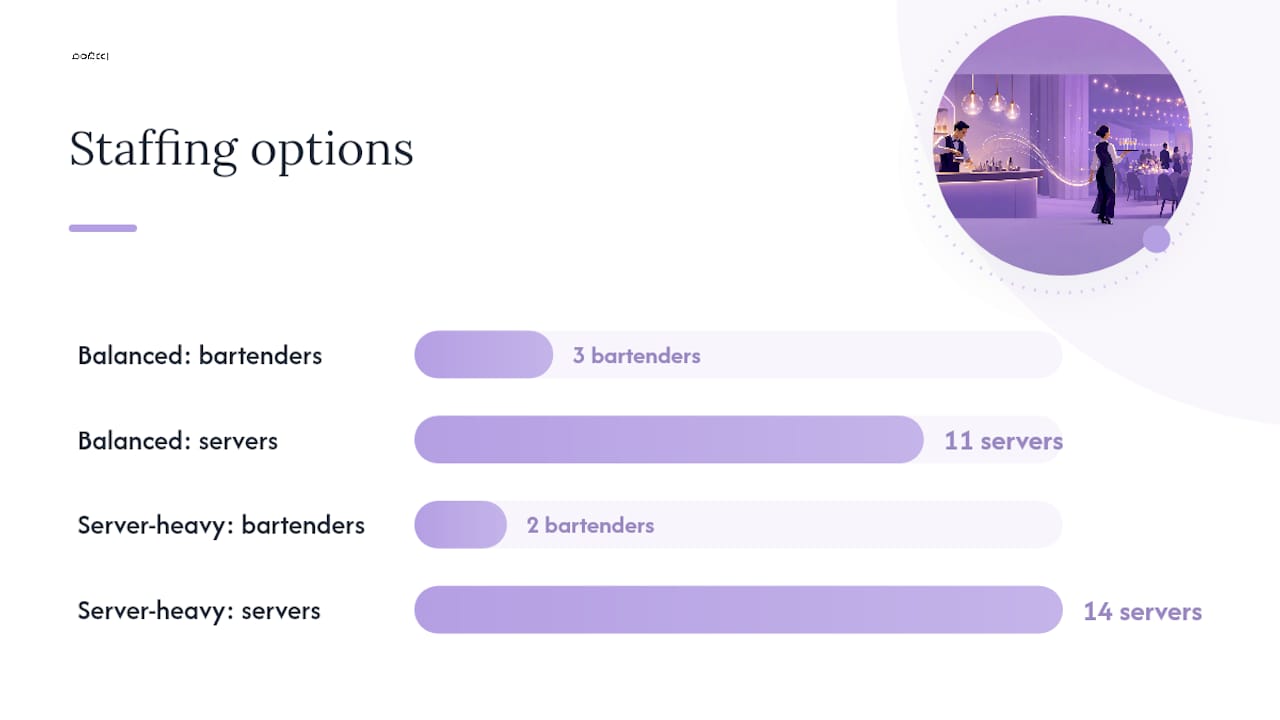
• Balanced mix for a 150-guest wedding: 3 bartenders plus 11 servers tends to outperform 2 bartenders plus 14 servers at a similar total labor cost, because the bottleneck at most weddings is the bar, not the dining room.
Cutting bar staff to save money almost always backfires. A slow bar is the fastest way to sour a room before dinner even starts.
Start with one question: is this event driven by drinks, by food, or by both? That single answer points you toward bartenders, servers, or a combined crew.
Before you finalize numbers, run through this checklist:
1. What’s the occasion, and is there a distinct cocktail hour separate from the meal?
2. How complex is the drink menu, signature cocktails or a simple bar?
3. What’s the venue layout, one bar station or several spread across a room?
4. When are your peak windows, and do they overlap with course service?
5. Do you have backup or floater staff if a peak runs longer than planned?
Once you know your shape, bring these questions to any staffing vendor:
• How many barbacks are included per bartender, and is that ratio fixed or scalable?
• What’s each bartender’s experience with the specific drinks on my menu?
• What’s the server-to-course plan, and who’s assigned to clearing and glass pickup?
• How does the crew handle the handoff between cocktail hour and dinner service?
• Vetting this matters. Staff without event-specific experience tend to create the on-the-fly corrections that show up as slow drinks or missed courses.
Pro Tip: If a vendor’s quote doesn’t mention barbacks or runners separately from bartenders and servers, ask why. A quote that only counts customer-facing staff usually means support roles got skipped, and that’s exactly where bottlenecks start.
Watch for a proposal that assumes flat coverage across your whole timeline. Peak windows need more staff than average demand suggests, and a quote built on averages will leave you short right when it matters.
The mistake we see most often is underestimating cocktail hour. Hosts plan staffing around the full event’s guest count instead of that one 60 to 90 minute window when almost every guest wants a drink at the same time. That’s when lines form, and that’s when the whole night’s energy takes a hit before dinner is even served.
The fix is usually simple. Add a barback so your bartender never leaves the station to grab ice. Stage a floater who can jump in during the rush and step back once things settle. If the menu allows it, shorten the cocktail-hour drink list to two or three pre-batched options, since fewer ingredients mean faster pours and higher throughput per bartender. Staff for your busiest fifteen minutes, not your average hour, and the rest of the night takes care of itself.
— PORCCI
Some event services offer a coordinated approach to staffing across New York City and New Jersey. If you’re throwing a signature-cocktail party, we’ll pair a bartender with a barback and a mobile bar setup so the drink line never becomes the story of the night. Planning a plated wedding? We staff servers, runners, and a captain who keeps the room moving on cue. Running a corporate event with a cocktail hour that rolls straight into dinner? We build a mixed crew sized to your actual peak windows, not just your total guest count.
Staffing is just one piece. Porcci NYC also handles the DJ services and AV and sound system rentals that fill out the rest of the night, all with setup, delivery, and breakdown included. If you’ve got dates coming up, request a quote and we’ll walk through the right staffing mix for your guest count and menu.
The ratios and role breakdowns in this article draw on the Event Staffing Calculator from HospitalityCalculators, which lets you plug in your own guest count and service style to test different staffing mixes. It’s worth running your own numbers there, especially if your venue layout or bar menu is more complex than a standard sit-down dinner. For menu planning that affects your staffing math, Wild Foodz’s rundown of festive meal offerings is a useful companion resource.
• Event Staffing Calculator for Catering & Events — HospitalityCalculators
• Event Staff Bartender vs Event Staff Server — ZipRecruiter
• Event Staffing Ratio Guide: Servers, Bartenders & Chefs Explained — Serve & Savour
For very small gatherings, yes, but it slows both jobs down once guest counts pass roughly 20 to 30 people, and it’s the most common cause of split-attention service failures.
Plan on two bartenders for a mixed-drink menu, or one if you’re running a simple beer-and-wine bar, following the 35 to 75 guest per bartender range.
Yes, though at a lower ratio than plated dinners since guests serve themselves; budget servers mainly for clearing, drink refills, and table maintenance.
A bartender produces and pours drinks at a fixed station, while a waiter (or server) delivers food and drinks to tables and manages ongoing guest care throughout the meal.
Booking both through one staffing provider like Porcci NYC usually simplifies coordination between cocktail hour and dinner service compared to hiring each role separately.
Event planners: staff for your peak window, not the average hour. Get bartender to guest ratios, a checklist, and Porcci NYC staffing options.
For a cocktail-heavy party, book dedicated bartenders. For a plated dinner, book servers. For anything with a real cocktail hour followed by a seated meal, book both. A common starting point is roughly one bartender per 35 to 75 guests and one server per 12 to 15 for plated service, with the bartender count rising as your drink menu gets more ambitious. Check the staffing plans below before you lock numbers with a vendor.
TL;DR:
• Staffing for cocktail-heavy events requires dedicated bartenders and barbacks to handle peak hours efficiently and prevent long lines.
• For 150 guests, plan for around three bartenders, one barback, and approximately ten to twelve servers during dinner to ensure smooth service.
• Underestimating cocktail hour staffing can lead to long queues, so hire extra personnel or shorten the drink list during rushes to maintain flow.
• Giving vendors clear details about event structure, peak times, and drink complexity helps secure accurate staffing proposals and prevents shortages.
• Combining bartenders and servers with support roles from a single vendor simplifies coordination and offers better coverage during critical service windows.
• Bartender Duties vs Server Duties at Your Event
• How Many Bartenders and Servers Do You Actually Need?
• What Staffing Choices Do to Your Labor Costs
• How to Decide: Checklist and Vendor Questions
• What We See Go Wrong at the Bar (and How to Fix It)
• Let Porcci NYC Handle the Staffing Mix
• Where These Numbers Come From
• Sources
• FAQ
Bartenders and servers solve two completely different problems, and mixing them up is where most staffing plans go sideways.
A bartender’s job is production and speed. They build drinks, manage a bar station under pressure, track inventory so nobody runs dry mid-toast, and coordinate with a barback who is restocking ice, garnishes, and glassware behind them. During a rush, a good bartender is running four or five orders at once while still keeping an eye on the line forming three deep.
A server’s job is continuity. They carry trays, clear plates, refill water, time courses with the kitchen, and keep tabs on which table needs what without being asked. It’s a different rhythm entirely. Where a bartender’s whole day is bursts of speed followed by lulls, a server’s day is steady attention spread across a room.
Here’s where the two roles overlap, and where that overlap becomes a problem:
• Small events sometimes ask one person to pour drinks and run food. It works for 20 people. It falls apart at 80.
• Asking a server to also handle a bar station during a busy cocktail hour means someone’s drink order waits behind someone’s dinner plate.
• Dedicated bartenders for cocktail-heavy stretches prevent the split-attention problem that industry staffing guidance flags as the most common service failure at larger events. Splitting the roles keeps both moving at full speed instead of one waiting on the other.
Pro Tip: If your cocktail hour and your dinner service overlap even slightly, that’s your signal to staff both roles separately rather than asking one crew to cover the transition.
Ratios shift depending on what’s being poured and what’s being plated, but a few benchmarks hold up across most events.
For bartenders, plan on one per 35 to 75 guests, with the lower end reserved for cocktail-forward menus and the higher end fine for a simple beer-and-wine setup. For servers, plated dinners run about one server per 12 to 15 guests, while cocktail receptions with passed apps stretch to one per 25 to 30. Add barbacks at roughly one for every two bartenders once you’re running a real cocktail program, and bring in runners once your server count climbs past six or seven.
Here’s what that looks like in practice:
1. 50 guests, cocktail reception: 1 bartender, 1 barback, 2 passed-service servers.
2. 150 guests, wedding with cocktail hour and plated dinner: 2 to 3 bartenders during cocktail hour, 1 barback, 10 to 12 servers for dinner, 1 captain to run the floor.
3. 300 guests, corporate gala with open bar: 4 to 5 bartenders, 2 barbacks, 20 to 24 servers depending on plated vs. buffet, 2 captains, plus floaters covering breaks.
A menu with three or four signature cocktails needs more bar labor than a straightforward gin-and-tonic setup, since every specialty drink adds prep steps that slow throughput. If your event has a separate cocktail-hour bar apart from the main reception bar, staff it as its own station rather than folding it into your overall headcount average.
Every extra body on the floor is an hourly rate, and most vendors have minimums that make a two-person booking almost as expensive as a four-person one.
The real cost drivers are hourly rates, shift minimums, overtime once an event runs long, and support roles like barbacks and bussers that don’t touch guests directly but keep everyone else moving. Multiple bar stations multiply your bartender need fast, since each station needs its own coverage rather than shared staff running between them.
• More bartenders, fewer servers: faster drinks, shorter lines, but dinner service can feel thin if you didn’t budget separately for the meal.
• More servers, minimal bar staff: smooth plated service, but guests queue at the bar and cocktail hour drags.
• Balanced mix for a 150-guest wedding: 3 bartenders plus 11 servers tends to outperform 2 bartenders plus 14 servers at a similar total labor cost, because the bottleneck at most weddings is the bar, not the dining room.
Cutting bar staff to save money almost always backfires. A slow bar is the fastest way to sour a room before dinner even starts.
Start with one question: is this event driven by drinks, by food, or by both? That single answer points you toward bartenders, servers, or a combined crew.
Before you finalize numbers, run through this checklist:
1. What’s the occasion, and is there a distinct cocktail hour separate from the meal?
2. How complex is the drink menu, signature cocktails or a simple bar?
3. What’s the venue layout, one bar station or several spread across a room?
4. When are your peak windows, and do they overlap with course service?
5. Do you have backup or floater staff if a peak runs longer than planned?
Once you know your shape, bring these questions to any staffing vendor:
• How many barbacks are included per bartender, and is that ratio fixed or scalable?
• What’s each bartender’s experience with the specific drinks on my menu?
• What’s the server-to-course plan, and who’s assigned to clearing and glass pickup?
• How does the crew handle the handoff between cocktail hour and dinner service?
• Vetting this matters. Staff without event-specific experience tend to create the on-the-fly corrections that show up as slow drinks or missed courses.
Pro Tip: If a vendor’s quote doesn’t mention barbacks or runners separately from bartenders and servers, ask why. A quote that only counts customer-facing staff usually means support roles got skipped, and that’s exactly where bottlenecks start.
Watch for a proposal that assumes flat coverage across your whole timeline. Peak windows need more staff than average demand suggests, and a quote built on averages will leave you short right when it matters.
The mistake we see most often is underestimating cocktail hour. Hosts plan staffing around the full event’s guest count instead of that one 60 to 90 minute window when almost every guest wants a drink at the same time. That’s when lines form, and that’s when the whole night’s energy takes a hit before dinner is even served.
The fix is usually simple. Add a barback so your bartender never leaves the station to grab ice. Stage a floater who can jump in during the rush and step back once things settle. If the menu allows it, shorten the cocktail-hour drink list to two or three pre-batched options, since fewer ingredients mean faster pours and higher throughput per bartender. Staff for your busiest fifteen minutes, not your average hour, and the rest of the night takes care of itself.
— PORCCI
Some event services offer a coordinated approach to staffing across New York City and New Jersey. If you’re throwing a signature-cocktail party, we’ll pair a bartender with a barback and a mobile bar setup so the drink line never becomes the story of the night. Planning a plated wedding? We staff servers, runners, and a captain who keeps the room moving on cue. Running a corporate event with a cocktail hour that rolls straight into dinner? We build a mixed crew sized to your actual peak windows, not just your total guest count.
Staffing is just one piece. Porcci NYC also handles the DJ services and AV and sound system rentals that fill out the rest of the night, all with setup, delivery, and breakdown included. If you’ve got dates coming up, request a quote and we’ll walk through the right staffing mix for your guest count and menu.
The ratios and role breakdowns in this article draw on the Event Staffing Calculator from HospitalityCalculators, which lets you plug in your own guest count and service style to test different staffing mixes. It’s worth running your own numbers there, especially if your venue layout or bar menu is more complex than a standard sit-down dinner. For menu planning that affects your staffing math, Wild Foodz’s rundown of festive meal offerings is a useful companion resource.
• Event Staffing Calculator for Catering & Events — HospitalityCalculators
• Event Staff Bartender vs Event Staff Server — ZipRecruiter
• Event Staffing Ratio Guide: Servers, Bartenders & Chefs Explained — Serve & Savour
For very small gatherings, yes, but it slows both jobs down once guest counts pass roughly 20 to 30 people, and it’s the most common cause of split-attention service failures.
Plan on two bartenders for a mixed-drink menu, or one if you’re running a simple beer-and-wine bar, following the 35 to 75 guest per bartender range.
Yes, though at a lower ratio than plated dinners since guests serve themselves; budget servers mainly for clearing, drink refills, and table maintenance.
A bartender produces and pours drinks at a fixed station, while a waiter (or server) delivers food and drinks to tables and manages ongoing guest care throughout the meal.
Booking both through one staffing provider like Porcci NYC usually simplifies coordination between cocktail hour and dinner service compared to hiring each role separately.