Discover event budget planning explained in our 2026 guide. Learn essential tips for tracking expenses and maximizing your event's success!
TL;DR:
• Effective event budget planning involves identifying fixed and variable costs, establishing a contingency fund, and continuously updating expenses throughout planning. A well-structured proposal with clear revenue projections, multiple scenarios, and transparent line items improves stakeholder approval. Consistent live tracking and capacity analysis are crucial to prevent overspending and ensure the event remains financially solvent.
Event budget planning is the process of building a detailed financial roadmap that aligns projected expenses with expected revenue so your event stays solvent from first deposit to final payment. Whether you are organizing a corporate conference in Midtown Manhattan, a wedding in New Jersey, or a private bar mitzvah, the same financial discipline applies. Tools like EventMobi and Eventtia help planners track line items digitally, but the structure behind any solid budget follows consistent principles. This guide covers event budget planning explained from the ground up, including cost categories, proposal writing, expense tracking, and how venue capacity directly shapes your numbers.
An event budget has four structural pillars: fixed costs, variable costs, revenue, and a contingency fund. Understanding each one prevents the most common planning mistake, which is treating all costs as equal.
Fixed costs stay constant regardless of how many people attend. Venue rental, event insurance, permits, and AV equipment rentals fall here. You pay the same amount whether 50 or 500 guests show up. Reviewing your event insurance costs early locks in one of your largest fixed line items before other decisions cascade from it.
Variable costs scale directly with attendance. Catering, staffing, printed programs, and favor items all increase per head. This distinction matters because it changes how you model financial risk.
Here is how typical event budgets break down by category:
• Venue: 25–35% of total budget, making it the single largest expense for most events
• Catering and beverages: 20–30%, the second largest category and the most volatile
• Entertainment and AV: 10–15%, including DJ services, photo booths, and sound systems
• Marketing and promotion: 5–10%, higher for ticketed public events
• Staffing: 5–10%, scaling with event size and complexity
• Contingency fund: 10–20% of total budget reserved for unexpected costs
That contingency range is not optional padding. It is the financial buffer that keeps an event from collapsing when a vendor cancels or a last-minute AV upgrade becomes necessary.
A category-first budgeting approach builds the expense structure around categories before filling in individual line items. This method catches hidden overhead costs, like generator rentals or coat check staffing, that planners miss when they start with a line-item list.
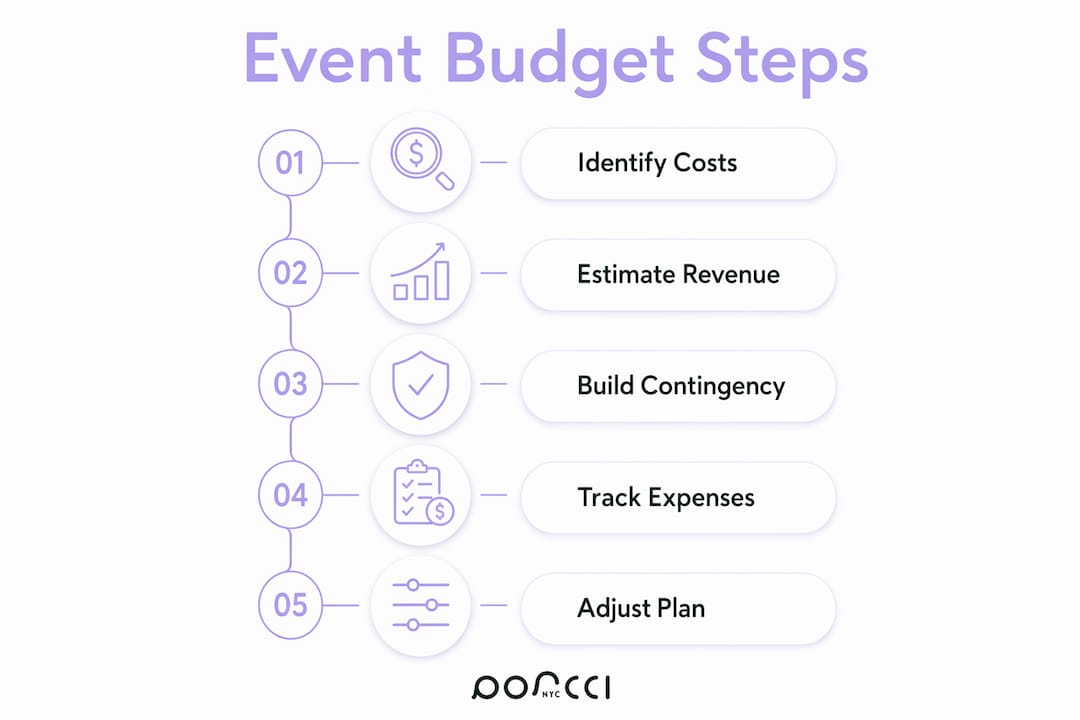
Pro Tip: Start every budget with your category headers blank and ask yourself what could go wrong in each one. That exercise surfaces costs you would never think to add from a blank spreadsheet.
A budget proposal is a communication tool first and a financial document second. Stakeholders approve budgets they understand, not budgets that are technically accurate but confusing.
Follow these steps to build a proposal that moves through approval quickly:
1. State the financial intent upfront. Decide whether the event is designed to generate profit, break even, or operate at a strategic loss (as some brand-building corporate events do). This single decision shapes every number that follows.
2. List all revenue sources with realistic projections. Ticket sales, sponsorships, exhibitor fees, and merchandise all belong here. Conservative revenue projections and multiple attendance scenarios reduce financial risk and demonstrate credibility to approvers.
3. Build a profit and loss projection for at least three scenarios. Model 60%, 80%, and 100% attendance. This shows stakeholders you have thought through downside risk.
4. Include a sponsorship offset strategy. Show exactly which expense categories a sponsor’s contribution covers. This makes the value of each sponsorship concrete rather than abstract.
5. Break every category into clear line items. Vague entries like “miscellaneous” erode trust. A clear budget proposal with a line-item breakdown and sponsorship offset strategy leads to faster stakeholder sign-off.
For corporate events specifically, aligning your proposal format with your organization’s existing financial reporting style reduces friction. Reviewing corporate event planning practices before drafting your proposal helps you match the language your finance team already uses.

Tracking expenses is where most budgets fail. The plan looks solid on paper, then small decisions accumulate and erode the contingency fund before the event date arrives.
Most budgeting failures come from gradual erosion through small, poorly tracked decisions rather than one large overspend. That means the discipline of live tracking matters more than the quality of the original estimate.
Effective expense control comes down to these practices:
• Compare estimates to actuals in real time. Update your budget document every time a vendor quote arrives, a deposit clears, or a scope change is agreed upon. Treat it as a living record, not a static plan.
• Manage cash flow separately from total budget. Cash flow timing differs from total budget size. Staggered payment schedules require venue deposits 6–12 months out, vendor deposits of 30–50% at contract signing, and final payments 14–30 days before the event. Running out of cash before the event date is a real risk even when the total budget is technically balanced.
• Avoid the lowest vendor quote. The cheapest quote often hides risks like unreliable equipment or inadequate staffing. The middle quote reflects realistic market pricing and protects you from surprises.
• Prioritize spend on what guests actually value. Spending based on guest value rather than low-impact extras keeps the attendee experience strong without inflating costs.
• Budget variable costs at 80% attendance initially. Planning variable costs for 80% attendance and scaling up as registrations confirm prevents overspending on catering and staffing before headcount is firm.
Pro Tip: Set a weekly calendar reminder to update your budget document. A budget reviewed weekly catches drift early. A budget reviewed monthly catches it too late.
Venue capacity planning is the process of calculating how many guests a space can safely and comfortably hold, and it directly determines your variable cost totals. Start from the legal fire capacity limit set by the venue or local authority. That number is your absolute ceiling.
Production elements consume 20–30% of total floor area, including staging, DJ booths, photo booth setups, and lighting rigs. Subtract that percentage from usable floor space before calculating guest capacity.
The table below shows standard space allowances by event format:
| Event Format | Space Per Person | Budget Impact |
|---|---|---|
| Standing reception | 5 sq ft | Lower catering and staffing costs per head |
| Seated theater style | 7–8 sq ft | Moderate cost, no table service required |
| Banquet/dinner seating | 13–24 sq ft | Highest catering and staffing cost per head |
These measurements directly affect your variable cost totals. A banquet-style dinner for 200 guests requires significantly more floor space, more catering staff, and more table settings than a standing cocktail reception for the same headcount. Getting the format right before finalizing the venue locks in your variable cost baseline. Reviewing your event staffing needs alongside capacity numbers gives you an accurate staffing cost estimate before you commit to a venue contract.
Effective event budget planning requires separating fixed from variable costs, building in a contingency fund, and treating the budget as a document that updates throughout the planning process.
| Point | Details |
|---|---|
| Contingency fund is non-negotiable | Reserve 10–20% of total budget to cover unexpected costs without derailing the event. |
| Category-first structure prevents gaps | Build expense categories before line items to capture hidden overhead costs. |
| Cash flow differs from total budget | Plan staggered payment schedules to stay solvent at every stage of planning. |
| Capacity planning sets variable cost baselines | Calculate usable floor space and guest format before finalizing catering and staffing budgets. |
| Live tracking stops budget erosion | Update actuals weekly to catch small overspends before they compound. |
We have worked through enough events to say this plainly: the budget document is rarely the problem. The problem is how planners treat it after the first vendor meeting.
Most planners build a solid initial budget, get stakeholder approval, and then stop updating it. By week six, the document reflects the plan from month one, not the reality of month two. Deposits have cleared, scope has shifted, and the contingency fund has quietly absorbed three “small” additions that nobody flagged as budget decisions.
The fix is not a better spreadsheet template. The fix is treating the budget as the single source of financial truth for the event, updated every time money moves or a decision changes scope. That discipline is harder than it sounds when you are also managing vendor calls, venue walkthroughs, and guest logistics simultaneously.
We also see planners consistently overspend on elements guests do not notice and underspend on elements guests remember. A premium centerpiece upgrade rarely gets mentioned in post-event feedback. A great DJ, a photo booth that kept the energy up, or a karaoke setup that got everyone involved always does. Spend where the experience lives.
— PORCCI
Once your budget structure is in place, locking in entertainment costs early protects your contingency fund from late-stage price increases. Porcci NYC provides photo booths, DJ services, karaoke machines, lighting, and sound systems for events across New York City and New Jersey. Every rental includes delivery, setup, and breakdown, so your entertainment line item covers a complete service, not just equipment. Transparent package pricing means no surprise fees on invoice day. Start your booking process early to secure your preferred date and lock in your entertainment budget before other variable costs shift.
Event budget planning is the process of organizing all projected income and expenses into a structured financial plan that guides spending and controls costs throughout the event lifecycle.
Allocate 10–20% of your total budget as a contingency reserve to cover unexpected vendor changes, last-minute upgrades, or unforeseen logistical costs.
Venue costs typically represent 25–35% of the total event budget, making it the largest single expense category for most event types.
Venue capacity determines how many guests you can accommodate, which sets the baseline for all variable costs including catering, staffing, and seating. Production elements like staging and AV equipment consume 20–30% of usable floor area, reducing your effective guest capacity.
Start tracking actuals from the first deposit payment and update the budget document weekly. Waiting until the event date to reconcile estimates against actuals makes it impossible to course-correct in time.
Discover event budget planning explained in our 2026 guide. Learn essential tips for tracking expenses and maximizing your event's success!
TL;DR:
• Effective event budget planning involves identifying fixed and variable costs, establishing a contingency fund, and continuously updating expenses throughout planning. A well-structured proposal with clear revenue projections, multiple scenarios, and transparent line items improves stakeholder approval. Consistent live tracking and capacity analysis are crucial to prevent overspending and ensure the event remains financially solvent.
Event budget planning is the process of building a detailed financial roadmap that aligns projected expenses with expected revenue so your event stays solvent from first deposit to final payment. Whether you are organizing a corporate conference in Midtown Manhattan, a wedding in New Jersey, or a private bar mitzvah, the same financial discipline applies. Tools like EventMobi and Eventtia help planners track line items digitally, but the structure behind any solid budget follows consistent principles. This guide covers event budget planning explained from the ground up, including cost categories, proposal writing, expense tracking, and how venue capacity directly shapes your numbers.
An event budget has four structural pillars: fixed costs, variable costs, revenue, and a contingency fund. Understanding each one prevents the most common planning mistake, which is treating all costs as equal.
Fixed costs stay constant regardless of how many people attend. Venue rental, event insurance, permits, and AV equipment rentals fall here. You pay the same amount whether 50 or 500 guests show up. Reviewing your event insurance costs early locks in one of your largest fixed line items before other decisions cascade from it.
Variable costs scale directly with attendance. Catering, staffing, printed programs, and favor items all increase per head. This distinction matters because it changes how you model financial risk.
Here is how typical event budgets break down by category:
• Venue: 25–35% of total budget, making it the single largest expense for most events
• Catering and beverages: 20–30%, the second largest category and the most volatile
• Entertainment and AV: 10–15%, including DJ services, photo booths, and sound systems
• Marketing and promotion: 5–10%, higher for ticketed public events
• Staffing: 5–10%, scaling with event size and complexity
• Contingency fund: 10–20% of total budget reserved for unexpected costs
That contingency range is not optional padding. It is the financial buffer that keeps an event from collapsing when a vendor cancels or a last-minute AV upgrade becomes necessary.
A category-first budgeting approach builds the expense structure around categories before filling in individual line items. This method catches hidden overhead costs, like generator rentals or coat check staffing, that planners miss when they start with a line-item list.
Pro Tip: Start every budget with your category headers blank and ask yourself what could go wrong in each one. That exercise surfaces costs you would never think to add from a blank spreadsheet.
A budget proposal is a communication tool first and a financial document second. Stakeholders approve budgets they understand, not budgets that are technically accurate but confusing.
Follow these steps to build a proposal that moves through approval quickly:
1. State the financial intent upfront. Decide whether the event is designed to generate profit, break even, or operate at a strategic loss (as some brand-building corporate events do). This single decision shapes every number that follows.
2. List all revenue sources with realistic projections. Ticket sales, sponsorships, exhibitor fees, and merchandise all belong here. Conservative revenue projections and multiple attendance scenarios reduce financial risk and demonstrate credibility to approvers.
3. Build a profit and loss projection for at least three scenarios. Model 60%, 80%, and 100% attendance. This shows stakeholders you have thought through downside risk.
4. Include a sponsorship offset strategy. Show exactly which expense categories a sponsor’s contribution covers. This makes the value of each sponsorship concrete rather than abstract.
5. Break every category into clear line items. Vague entries like “miscellaneous” erode trust. A clear budget proposal with a line-item breakdown and sponsorship offset strategy leads to faster stakeholder sign-off.
For corporate events specifically, aligning your proposal format with your organization’s existing financial reporting style reduces friction. Reviewing corporate event planning practices before drafting your proposal helps you match the language your finance team already uses.
Tracking expenses is where most budgets fail. The plan looks solid on paper, then small decisions accumulate and erode the contingency fund before the event date arrives.
Most budgeting failures come from gradual erosion through small, poorly tracked decisions rather than one large overspend. That means the discipline of live tracking matters more than the quality of the original estimate.
Effective expense control comes down to these practices:
• Compare estimates to actuals in real time. Update your budget document every time a vendor quote arrives, a deposit clears, or a scope change is agreed upon. Treat it as a living record, not a static plan.
• Manage cash flow separately from total budget. Cash flow timing differs from total budget size. Staggered payment schedules require venue deposits 6–12 months out, vendor deposits of 30–50% at contract signing, and final payments 14–30 days before the event. Running out of cash before the event date is a real risk even when the total budget is technically balanced.
• Avoid the lowest vendor quote. The cheapest quote often hides risks like unreliable equipment or inadequate staffing. The middle quote reflects realistic market pricing and protects you from surprises.
• Prioritize spend on what guests actually value. Spending based on guest value rather than low-impact extras keeps the attendee experience strong without inflating costs.
• Budget variable costs at 80% attendance initially. Planning variable costs for 80% attendance and scaling up as registrations confirm prevents overspending on catering and staffing before headcount is firm.
Pro Tip: Set a weekly calendar reminder to update your budget document. A budget reviewed weekly catches drift early. A budget reviewed monthly catches it too late.
Venue capacity planning is the process of calculating how many guests a space can safely and comfortably hold, and it directly determines your variable cost totals. Start from the legal fire capacity limit set by the venue or local authority. That number is your absolute ceiling.
Production elements consume 20–30% of total floor area, including staging, DJ booths, photo booth setups, and lighting rigs. Subtract that percentage from usable floor space before calculating guest capacity.
The table below shows standard space allowances by event format:
| Event Format | Space Per Person | Budget Impact |
|---|---|---|
| Standing reception | 5 sq ft | Lower catering and staffing costs per head |
| Seated theater style | 7–8 sq ft | Moderate cost, no table service required |
| Banquet/dinner seating | 13–24 sq ft | Highest catering and staffing cost per head |
These measurements directly affect your variable cost totals. A banquet-style dinner for 200 guests requires significantly more floor space, more catering staff, and more table settings than a standing cocktail reception for the same headcount. Getting the format right before finalizing the venue locks in your variable cost baseline. Reviewing your event staffing needs alongside capacity numbers gives you an accurate staffing cost estimate before you commit to a venue contract.
Effective event budget planning requires separating fixed from variable costs, building in a contingency fund, and treating the budget as a document that updates throughout the planning process.
| Point | Details |
|---|---|
| Contingency fund is non-negotiable | Reserve 10–20% of total budget to cover unexpected costs without derailing the event. |
| Category-first structure prevents gaps | Build expense categories before line items to capture hidden overhead costs. |
| Cash flow differs from total budget | Plan staggered payment schedules to stay solvent at every stage of planning. |
| Capacity planning sets variable cost baselines | Calculate usable floor space and guest format before finalizing catering and staffing budgets. |
| Live tracking stops budget erosion | Update actuals weekly to catch small overspends before they compound. |
We have worked through enough events to say this plainly: the budget document is rarely the problem. The problem is how planners treat it after the first vendor meeting.
Most planners build a solid initial budget, get stakeholder approval, and then stop updating it. By week six, the document reflects the plan from month one, not the reality of month two. Deposits have cleared, scope has shifted, and the contingency fund has quietly absorbed three “small” additions that nobody flagged as budget decisions.
The fix is not a better spreadsheet template. The fix is treating the budget as the single source of financial truth for the event, updated every time money moves or a decision changes scope. That discipline is harder than it sounds when you are also managing vendor calls, venue walkthroughs, and guest logistics simultaneously.
We also see planners consistently overspend on elements guests do not notice and underspend on elements guests remember. A premium centerpiece upgrade rarely gets mentioned in post-event feedback. A great DJ, a photo booth that kept the energy up, or a karaoke setup that got everyone involved always does. Spend where the experience lives.
— PORCCI
Once your budget structure is in place, locking in entertainment costs early protects your contingency fund from late-stage price increases. Porcci NYC provides photo booths, DJ services, karaoke machines, lighting, and sound systems for events across New York City and New Jersey. Every rental includes delivery, setup, and breakdown, so your entertainment line item covers a complete service, not just equipment. Transparent package pricing means no surprise fees on invoice day. Start your booking process early to secure your preferred date and lock in your entertainment budget before other variable costs shift.
Event budget planning is the process of organizing all projected income and expenses into a structured financial plan that guides spending and controls costs throughout the event lifecycle.
Allocate 10–20% of your total budget as a contingency reserve to cover unexpected vendor changes, last-minute upgrades, or unforeseen logistical costs.
Venue costs typically represent 25–35% of the total event budget, making it the largest single expense category for most event types.
Venue capacity determines how many guests you can accommodate, which sets the baseline for all variable costs including catering, staffing, and seating. Production elements like staging and AV equipment consume 20–30% of usable floor area, reducing your effective guest capacity.
Start tracking actuals from the first deposit payment and update the budget document weekly. Waiting until the event date to reconcile estimates against actuals makes it impossible to course-correct in time.