Explore creative wedding emcee script ideas with templates designed for friends and family, ensuring a memorable celebration for all!
“Good evening, everyone. On behalf of [Couple’s Names], welcome. Please find your seats, and let’s get this celebration started.” Say that line with a smile and you’ve already cleared the hardest part of the night: opening your mouth in front of a room full of people watching you.
Here’s why a script this short works. Across a typical five-hour reception, the emcee usually talks for only about 15 to 20 minutes total. Your job isn’t to entertain, it’s to cue. The rest of this guide gives you a full run-sheet, copy-ready lines for every reception moment, two complete sample scripts, and a checklist to keep in your pocket. Along the way we’ll fold in the vendor coordination habits that keep the night moving, straight from how event pros at Porcci NYC approach a room.
Pro Tip: Print your script and run-sheet even if you’re reading from your phone. Battery dies, screens dim under stage lighting, and paper never crashes.
Three lines to memorize right now:
• Welcome: “Welcome, everyone. We’re so glad you’re here to celebrate [Names].”
• Toast intro: “Please raise your glass and join me in welcoming [Speaker], to say a few words.”
• Closing: “That’s a wrap on tonight’s celebration. Thank you for making this day unforgettable, and travel safe.”
A confident wedding emcee succeeds by pairing short, rehearsed script lines with tight behind-the-scenes coordination with the DJ, photographer, and caterer.
| Point | Details |
|---|---|
| Keep total talk time short | Plan for roughly 15 to 20 minutes of speaking across a five-hour reception. |
| Script every key moment | Prepare one to two sentence lines for welcomes, introductions, toasts, and transitions. |
| Confirm vendor signals first | Wait for a photographer or DJ cue before announcing photo-dependent moments. |
| Carry paper backups | Bring a printed script, run-sheet, and phonetic name list in case tech fails. |
| Consider professional support | Porcci NYC offers wireless mic, sound system, and DJ/MC staffing packages for couples who want the coordination handled for them. |
For deeper examples, the Pro DJs Australia script template covers all 14 common reception moments with fillable wording, and WeddingVenture’s MC guide breaks down how to brief speakers and build a timeline.
• What Does a Wedding Emcee Actually Do?
• What Does a Typical Reception Timeline Look Like?
• What Should the Emcee Say for Every Reception Moment?
• Two Full Sample Scripts to Copy and Adapt
• How Do You Prepare Before the Reception Starts?
• What Belongs on Your One-Page Emcee Checklist?
• Why the MC’s Real Job Happens Off the Mic
• Prefer to Hand the Mic to a Pro?
• Sources
An emcee’s real job is coordination, not comedy. You guide the timeline, introduce speakers, signal vendors, and keep the room’s energy up without ever becoming the center of attention. A dedicated MC keeps the reception on schedule and handles introductions, transitions, and behind-the-scenes logistics, which means most of your value happens before you ever pick up the mic.
Follow this three-step plan and you’ll walk in prepared:
• Pre-event check-in: Meet the DJ, photographer, and caterer 30 to 60 minutes before guests arrive.
• Run-sheet confirmation: Walk through the timeline together and agree on hand signals for “ready” and “hold.”
• Signal and announce routine: Wait for the vendor cue, then deliver your line. Never announce a moment the camera team hasn’t confirmed.
Pro Tip: Carry a printed run-sheet AND a phonetic name list. Muffing a grandmother’s name is the one mistake guests remember for years.
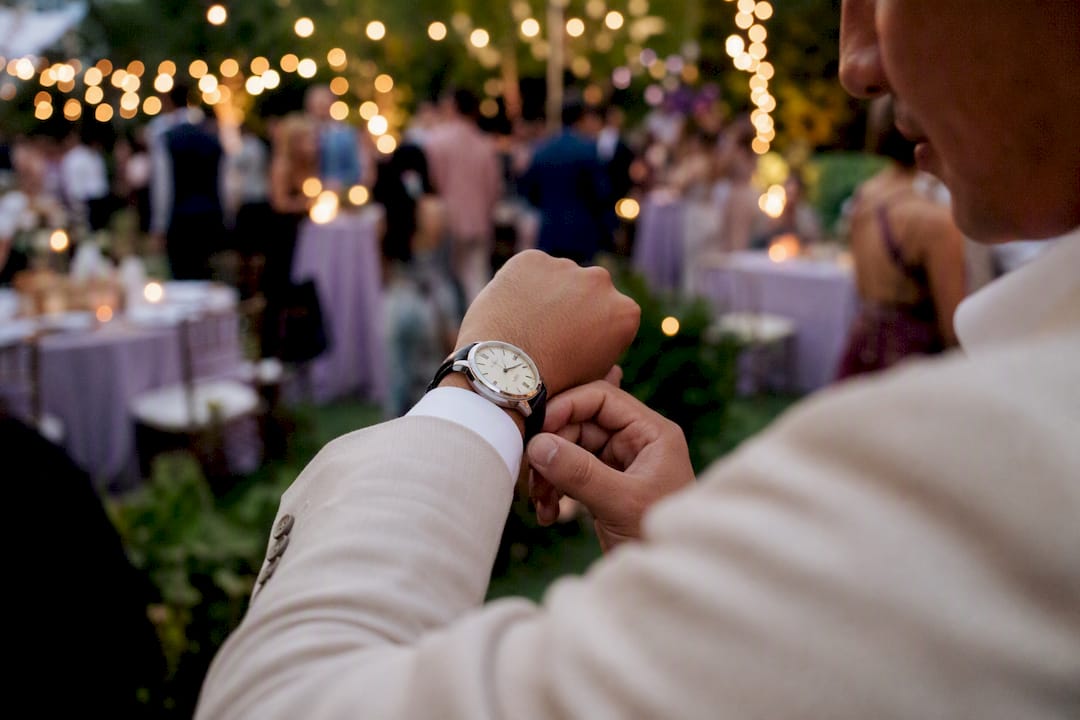
A standard five-hour reception breaks into predictable chunks, and knowing where you sit in that flow tells you when to be near the mic and when you can relax.
| Time | Moment | Emcee Role |
|---|---|---|
| — | Guest arrival | Greet, direct to seating |
| — | Welcome + housekeeping | Opening announcement |
| — | Grand entrance | Introduce wedding party |
| — | Dinner service | Light background cues only |
| — | Toasts and speeches | Introduce each speaker |
| — | First dance, parent dances | Transition announcements |
| 2:20–2:30 | Cake cutting | Short cue |
| 2:30–4:30 | Open dance floor | Occasional energy checks |
| — | Send-off | Closing remarks |
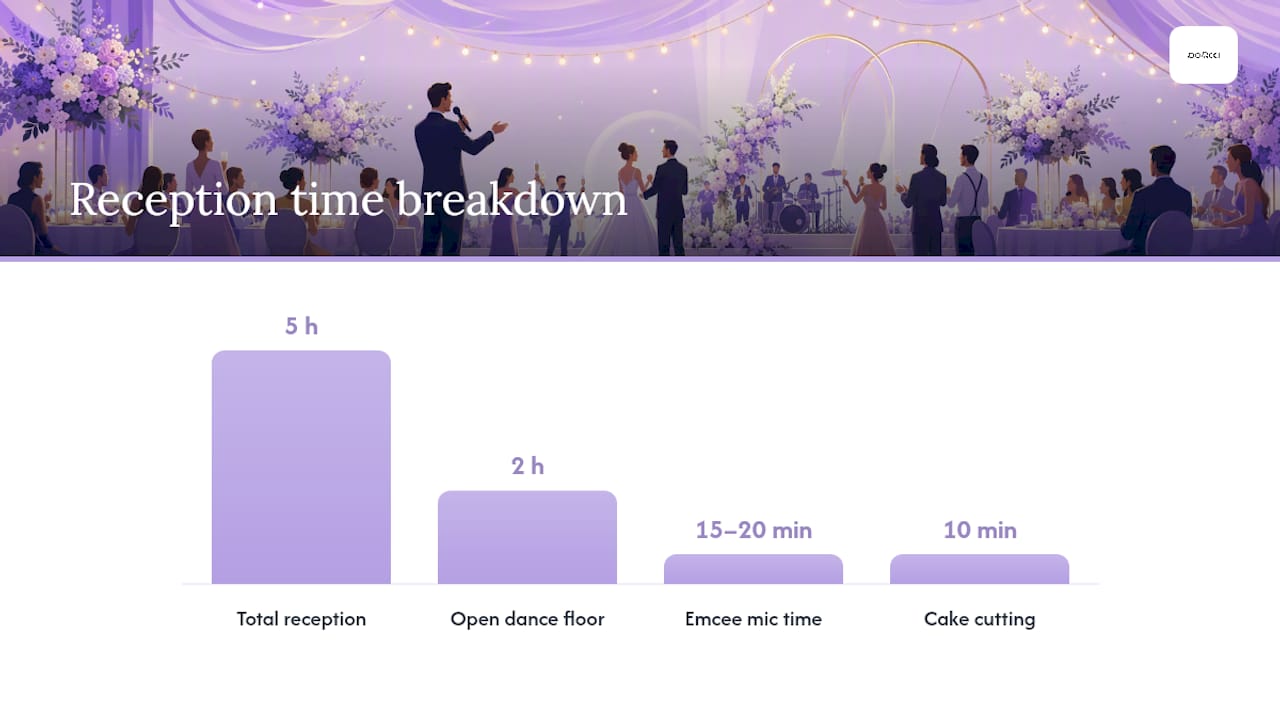
For shorter or cocktail-style events, compress dinner and toasts into one block and trim open dancing. Longer receptions just stretch the dance-floor window, not your speaking time. Your total mic time across the night still lands around 15 to 20 minutes, so resist the urge to fill silence with extra chatter.
Think of your script as a toolbox, not a speech. Grab the line that fits, swap in names, and move on.
Arrival and housekeeping:
• Formal: “Good evening. Restrooms are located [location], and for helpful phrasing on announcements like this, see polite phrases that work to gently guide your guests.”
• Casual: “Hey everyone, thanks for coming! Bathrooms are down that hallway, and if you spot a wishing well, [Couple’s Names] would love a note instead of a card.”
Wedding party introductions: Keep grand-entrance lines to one sentence per pair: “Please welcome [Name] and [Name]!” Practice tricky names out loud with the couple beforehand, not for the first time on the mic.
Toast and speech introductions:
• “Please welcome [Speaker], [relationship to couple], to share a few words.”
• When you have four or more speakers, tell each one their time limit privately, then use a light line if someone runs long: “Let’s give one more round of applause as we move to our next speaker.”
Transitions for dances and cake:
• “Let’s welcome [Names] to the floor for their first dance.”
• “It’s time to cut the cake. [Names], the floor is yours.”
• “The dance floor is officially open. Let’s celebrate!”
Handling hiccups without drama: If a speaker is missing, skip to the next one and circle back later: “We’ll catch [Name]'s toast in just a bit. Right now, let’s welcome [Next Speaker].” If the mic cuts out, switch to your backup immediately and keep talking through the gap. Guests forgive a two-second pause; they remember an emcee who panics.
A complete reception script typically runs four to six pages and covers roughly 14 short announcements. Here are two compressed versions showing how the pieces connect.
Formal script (compact):
1. Entrance: “Ladies and gentlemen, please welcome for the first time, Mr. and Mrs. [Last Name].”
2. Welcome: “On behalf of the family, welcome to this celebration of love.”
3. Dinner cue: “Dinner will now be served. Please enjoy.”
4. Toast intro: “Please join me in welcoming the best man, [Name].”
5. First dance: “Please welcome the couple for their first dance.”
6. Cake: “It’s time for the cake cutting.”
7. Closing: “Thank you for celebrating with us tonight.”
Casual script (friends-and-family tone):
• “Everybody get loud, here come [Names]!”
• “We’ve got dinner coming out, so grab a seat and dig in.”
• “This next toast is from someone who’s known the groom since third grade, [Name].”
• “Alright, floor’s open, let’s dance!”
Editing notes: swap bracketed names, add a cultural moment (like a bouquet toss or a tea ceremony cue) where it fits the run-sheet, and keep each announcement under 30 seconds so energy never dips.
Preparation is where good emcees separate themselves from nervous ones. Build a checklist a week out: phonetic name list, printed run-sheet, individual speaker briefings, a backup mic, and your full script printed in large font.
Professional MCs recommend over-communicating with the photographer and videographer so key moments like the first dance or cake cutting only start once the camera team gives the nod. Confirm this signal in person, not by text.
Run the full script out loud once, ideally with the couple present, so your tone matches their vibe. Build a 15-minute buffer into the timeline; something always runs late. If a speaker is delayed, keep the room moving with a quick transition rather than dead air. If a plate is late reaching a table, a light joke and a segue to the next agenda item covers the gap without drawing attention to it.
Pro Tip: Brief every speaker individually about their time limit before the reception starts, not five minutes before they’re announced.
Print this and tuck it in your jacket or clutch:
1. Printed script and run-sheet (two copies)
2. Phonetic name list for wedding party and speakers
3. Vendor contact list (DJ, photographer, caterer)
4. Backup mic or spare batteries confirmed with the DJ
Fill in each row during your pre-event walkthrough, then jot live updates (delays, skipped items) in the margins as the night unfolds. That blank template becomes your single source of truth when things shift.
The words you say matter far less than the coordination behind them. Meet every vendor the moment you arrive, confirm the run-sheet, and lock in camera-ready positions before a single guest sits down. Successful MCs treat the role as coordination first: check in with vendors, confirm positions, and wait for their signal before starting a key moment, rather than assuming the room is ready because the clock says so.
Energy management matters too. Speeches call for calm, steady pacing. The dance floor calls for volume and urgency. Reading which mode the room needs, and shifting fast, matters more than any joke in your script.
Plenty of couples ask a friend to emcee because it’s personal, and that instinct is a good one. But if the idea of running sound checks, chasing down a wireless mic, and coordinating three vendors on top of giving a speech sounds like too much, there’s another route. Porcci NYC supplies wireless microphones, full sound systems, and DJ or MC staffing built for exactly this kind of night, so the coordination work doesn’t fall entirely on one nervous friend.
A rental and staffing package means someone else owns the sound check, the backup mic, and the vendor signals we just walked through, while your friend or family member still gets to make the toast intros personal. Whether you need a standalone wireless mic and sound system or a full DJ and MC service, request a quote and Porcci NYC will bundle it around your existing run-sheet.
• Do You Need a Wedding MC? Duties, Cost & How to Find — The Knot
• Should You Hire a Wedding MC for Your Reception? — Brides
• Wedding MC Script & Running Order Template — Pro DJs Australia
• How to MC a Wedding — Marry Us Gary
A good script is short and modular: one to two sentences per moment (welcome, introductions, toasts, transitions, closing) rather than one long speech, so you can adapt on the fly if the timeline shifts.
Cover the essentials: a welcome, housekeeping notes, introductions of the wedding party, brief toast intros, transition cues for dances and cake, and a closing thank-you, each kept under 30 seconds.
An officiant’s ceremony script typically includes a welcome, readings or vows, the ring exchange, and the pronouncement, which is separate from the emcee’s reception script covering introductions and toasts.
A trusted friend brings a personal touch and lower cost, while a professional or a staffed service like Porcci NYC’s DJ and MC offering removes day-of coordination work like vendor signaling and mic troubleshooting.
Keep each announcement under 30 seconds; across the full reception, your total spoken time should land around 15 to 20 minutes.
Explore creative wedding emcee script ideas with templates designed for friends and family, ensuring a memorable celebration for all!
“Good evening, everyone. On behalf of [Couple’s Names], welcome. Please find your seats, and let’s get this celebration started.” Say that line with a smile and you’ve already cleared the hardest part of the night: opening your mouth in front of a room full of people watching you.
Here’s why a script this short works. Across a typical five-hour reception, the emcee usually talks for only about 15 to 20 minutes total. Your job isn’t to entertain, it’s to cue. The rest of this guide gives you a full run-sheet, copy-ready lines for every reception moment, two complete sample scripts, and a checklist to keep in your pocket. Along the way we’ll fold in the vendor coordination habits that keep the night moving, straight from how event pros at Porcci NYC approach a room.
Pro Tip: Print your script and run-sheet even if you’re reading from your phone. Battery dies, screens dim under stage lighting, and paper never crashes.
Three lines to memorize right now:
• Welcome: “Welcome, everyone. We’re so glad you’re here to celebrate [Names].”
• Toast intro: “Please raise your glass and join me in welcoming [Speaker], to say a few words.”
• Closing: “That’s a wrap on tonight’s celebration. Thank you for making this day unforgettable, and travel safe.”
A confident wedding emcee succeeds by pairing short, rehearsed script lines with tight behind-the-scenes coordination with the DJ, photographer, and caterer.
| Point | Details |
|---|---|
| Keep total talk time short | Plan for roughly 15 to 20 minutes of speaking across a five-hour reception. |
| Script every key moment | Prepare one to two sentence lines for welcomes, introductions, toasts, and transitions. |
| Confirm vendor signals first | Wait for a photographer or DJ cue before announcing photo-dependent moments. |
| Carry paper backups | Bring a printed script, run-sheet, and phonetic name list in case tech fails. |
| Consider professional support | Porcci NYC offers wireless mic, sound system, and DJ/MC staffing packages for couples who want the coordination handled for them. |
For deeper examples, the Pro DJs Australia script template covers all 14 common reception moments with fillable wording, and WeddingVenture’s MC guide breaks down how to brief speakers and build a timeline.
• What Does a Wedding Emcee Actually Do?
• What Does a Typical Reception Timeline Look Like?
• What Should the Emcee Say for Every Reception Moment?
• Two Full Sample Scripts to Copy and Adapt
• How Do You Prepare Before the Reception Starts?
• What Belongs on Your One-Page Emcee Checklist?
• Why the MC’s Real Job Happens Off the Mic
• Prefer to Hand the Mic to a Pro?
• Sources
An emcee’s real job is coordination, not comedy. You guide the timeline, introduce speakers, signal vendors, and keep the room’s energy up without ever becoming the center of attention. A dedicated MC keeps the reception on schedule and handles introductions, transitions, and behind-the-scenes logistics, which means most of your value happens before you ever pick up the mic.
Follow this three-step plan and you’ll walk in prepared:
• Pre-event check-in: Meet the DJ, photographer, and caterer 30 to 60 minutes before guests arrive.
• Run-sheet confirmation: Walk through the timeline together and agree on hand signals for “ready” and “hold.”
• Signal and announce routine: Wait for the vendor cue, then deliver your line. Never announce a moment the camera team hasn’t confirmed.
Pro Tip: Carry a printed run-sheet AND a phonetic name list. Muffing a grandmother’s name is the one mistake guests remember for years.
A standard five-hour reception breaks into predictable chunks, and knowing where you sit in that flow tells you when to be near the mic and when you can relax.
| Time | Moment | Emcee Role |
|---|---|---|
| — | Guest arrival | Greet, direct to seating |
| — | Welcome + housekeeping | Opening announcement |
| — | Grand entrance | Introduce wedding party |
| — | Dinner service | Light background cues only |
| — | Toasts and speeches | Introduce each speaker |
| — | First dance, parent dances | Transition announcements |
| 2:20–2:30 | Cake cutting | Short cue |
| 2:30–4:30 | Open dance floor | Occasional energy checks |
| — | Send-off | Closing remarks |
For shorter or cocktail-style events, compress dinner and toasts into one block and trim open dancing. Longer receptions just stretch the dance-floor window, not your speaking time. Your total mic time across the night still lands around 15 to 20 minutes, so resist the urge to fill silence with extra chatter.
Think of your script as a toolbox, not a speech. Grab the line that fits, swap in names, and move on.
Arrival and housekeeping:
• Formal: “Good evening. Restrooms are located [location], and for helpful phrasing on announcements like this, see polite phrases that work to gently guide your guests.”
• Casual: “Hey everyone, thanks for coming! Bathrooms are down that hallway, and if you spot a wishing well, [Couple’s Names] would love a note instead of a card.”
Wedding party introductions: Keep grand-entrance lines to one sentence per pair: “Please welcome [Name] and [Name]!” Practice tricky names out loud with the couple beforehand, not for the first time on the mic.
Toast and speech introductions:
• “Please welcome [Speaker], [relationship to couple], to share a few words.”
• When you have four or more speakers, tell each one their time limit privately, then use a light line if someone runs long: “Let’s give one more round of applause as we move to our next speaker.”
Transitions for dances and cake:
• “Let’s welcome [Names] to the floor for their first dance.”
• “It’s time to cut the cake. [Names], the floor is yours.”
• “The dance floor is officially open. Let’s celebrate!”
Handling hiccups without drama: If a speaker is missing, skip to the next one and circle back later: “We’ll catch [Name]'s toast in just a bit. Right now, let’s welcome [Next Speaker].” If the mic cuts out, switch to your backup immediately and keep talking through the gap. Guests forgive a two-second pause; they remember an emcee who panics.
A complete reception script typically runs four to six pages and covers roughly 14 short announcements. Here are two compressed versions showing how the pieces connect.
Formal script (compact):
1. Entrance: “Ladies and gentlemen, please welcome for the first time, Mr. and Mrs. [Last Name].”
2. Welcome: “On behalf of the family, welcome to this celebration of love.”
3. Dinner cue: “Dinner will now be served. Please enjoy.”
4. Toast intro: “Please join me in welcoming the best man, [Name].”
5. First dance: “Please welcome the couple for their first dance.”
6. Cake: “It’s time for the cake cutting.”
7. Closing: “Thank you for celebrating with us tonight.”
Casual script (friends-and-family tone):
• “Everybody get loud, here come [Names]!”
• “We’ve got dinner coming out, so grab a seat and dig in.”
• “This next toast is from someone who’s known the groom since third grade, [Name].”
• “Alright, floor’s open, let’s dance!”
Editing notes: swap bracketed names, add a cultural moment (like a bouquet toss or a tea ceremony cue) where it fits the run-sheet, and keep each announcement under 30 seconds so energy never dips.
Preparation is where good emcees separate themselves from nervous ones. Build a checklist a week out: phonetic name list, printed run-sheet, individual speaker briefings, a backup mic, and your full script printed in large font.
Professional MCs recommend over-communicating with the photographer and videographer so key moments like the first dance or cake cutting only start once the camera team gives the nod. Confirm this signal in person, not by text.
Run the full script out loud once, ideally with the couple present, so your tone matches their vibe. Build a 15-minute buffer into the timeline; something always runs late. If a speaker is delayed, keep the room moving with a quick transition rather than dead air. If a plate is late reaching a table, a light joke and a segue to the next agenda item covers the gap without drawing attention to it.
Pro Tip: Brief every speaker individually about their time limit before the reception starts, not five minutes before they’re announced.
Print this and tuck it in your jacket or clutch:
1. Printed script and run-sheet (two copies)
2. Phonetic name list for wedding party and speakers
3. Vendor contact list (DJ, photographer, caterer)
4. Backup mic or spare batteries confirmed with the DJ
Fill in each row during your pre-event walkthrough, then jot live updates (delays, skipped items) in the margins as the night unfolds. That blank template becomes your single source of truth when things shift.
The words you say matter far less than the coordination behind them. Meet every vendor the moment you arrive, confirm the run-sheet, and lock in camera-ready positions before a single guest sits down. Successful MCs treat the role as coordination first: check in with vendors, confirm positions, and wait for their signal before starting a key moment, rather than assuming the room is ready because the clock says so.
Energy management matters too. Speeches call for calm, steady pacing. The dance floor calls for volume and urgency. Reading which mode the room needs, and shifting fast, matters more than any joke in your script.
Plenty of couples ask a friend to emcee because it’s personal, and that instinct is a good one. But if the idea of running sound checks, chasing down a wireless mic, and coordinating three vendors on top of giving a speech sounds like too much, there’s another route. Porcci NYC supplies wireless microphones, full sound systems, and DJ or MC staffing built for exactly this kind of night, so the coordination work doesn’t fall entirely on one nervous friend.
A rental and staffing package means someone else owns the sound check, the backup mic, and the vendor signals we just walked through, while your friend or family member still gets to make the toast intros personal. Whether you need a standalone wireless mic and sound system or a full DJ and MC service, request a quote and Porcci NYC will bundle it around your existing run-sheet.
• Do You Need a Wedding MC? Duties, Cost & How to Find — The Knot
• Should You Hire a Wedding MC for Your Reception? — Brides
• Wedding MC Script & Running Order Template — Pro DJs Australia
• How to MC a Wedding — Marry Us Gary
A good script is short and modular: one to two sentences per moment (welcome, introductions, toasts, transitions, closing) rather than one long speech, so you can adapt on the fly if the timeline shifts.
Cover the essentials: a welcome, housekeeping notes, introductions of the wedding party, brief toast intros, transition cues for dances and cake, and a closing thank-you, each kept under 30 seconds.
An officiant’s ceremony script typically includes a welcome, readings or vows, the ring exchange, and the pronouncement, which is separate from the emcee’s reception script covering introductions and toasts.
A trusted friend brings a personal touch and lower cost, while a professional or a staffed service like Porcci NYC’s DJ and MC offering removes day-of coordination work like vendor signaling and mic troubleshooting.
Keep each announcement under 30 seconds; across the full reception, your total spoken time should land around 15 to 20 minutes.