Discover what is event client management and learn how it enhances client relationships, reduces errors, and boosts repeat bookings for planners.
TL;DR:
• Event client management involves handling all client interactions throughout their event journey to build lasting relationships. Effective communication, specialized tools, and timely follow-up turn one-time clients into repeat customers and generate referrals.
Event client management is the organized process of handling all client interactions, workflows, and communications from the first inquiry through post-event follow-up. The industry term for this practice is client lifecycle management, and it covers every touchpoint a planner has with a client. Done well, it reduces planning errors, builds trust, and turns one-time clients into repeat bookings. At Porcci NYC, we see planners struggle most when they treat client management as a series of tasks rather than a continuous relationship process. This article breaks down the core components, communication strategies, and technology tools that make event client management work.
Event client management is the full system a planner uses to move a client from inquiry to event completion and beyond. It covers lead capture, proposals, contracts, logistics coordination, day-of execution, and post-event retention. The goal is not just to run a good event. The goal is to build a client relationship that generates referrals and repeat business.
The lifecycle breaks into six clear stages:
1. Inquiry and lead qualification. Capture the lead, assess fit, and respond fast. Responding within one hour increases booking conversions by 22%. Speed signals professionalism before the first meeting.
2. Proposal, contract, and deposit. Send a detailed proposal, collect a signed contract, and secure a deposit. This stage sets financial and legal expectations clearly.
3. Kickoff meeting and intake. Run a 45–60 minute kickoff meeting and collect a completed intake form within 48 hours. This meeting is where you define communication rules and decision-making authority.
4. Vendor sourcing and timeline coordination. Source vendors, build the event timeline, and confirm logistics. Keep the client informed without overwhelming them with every detail.
5. Day-of execution. Run operational check-ins and manage real-time changes. The client should feel confident, not involved in every micro-decision.
6. Post-event close-out. Send final invoices, request reviews, and distribute satisfaction surveys. This stage is also the start of your retention strategy.
Each stage requires a different communication approach and a different set of tools. Planners who treat all six stages the same way lose clients at the handoff points.

Strong client communication follows a tiered cadence based on how close the event is. High-performing planners use biweekly check-ins when an event is three or more months away, weekly updates in the final two months, daily contact during event week, and a 48-hour wrap-up after the event. This structure prevents clients from feeling ignored or overwhelmed.
Every update message should cover three things:
• What changed since the last communication
• What the client needs to decide or approve
• What happens next and by when
Clients scan updates for exactly these three points. A structured message prevents misunderstandings and delayed decisions that push timelines back.
Setting decision-making authority in the kickoff meeting is equally critical. Explicit boundaries upfront prevent scope creep and reduce client frustration from misaligned expectations. Clients who know what they control and what you control make faster decisions.
Pro Tip: Personalize every automated message with at least one detail specific to the client’s event. Over-automating communications without personal event context damages client trust faster than infrequent updates.
Generic CRMs are built to close deals. Event client management requires more. Event CRMs convert closed deals into active event workspaces that hold timelines, vendor lists, and budgets in one place. That distinction matters because a planner’s work does not end at the signed contract. It starts there.
The table below shows how generic CRM features compare to event-specific CRM capabilities:
| Feature category | Generic CRM | Event CRM |
|---|---|---|
| Lead capture and tracking | Yes | Yes |
| Proposal and contract tools | Limited | Built-in |
| Live event workspace | No | Yes |
| Vendor and timeline management | No | Yes |
| Post-event follow-up automation | Basic | Structured sequences |
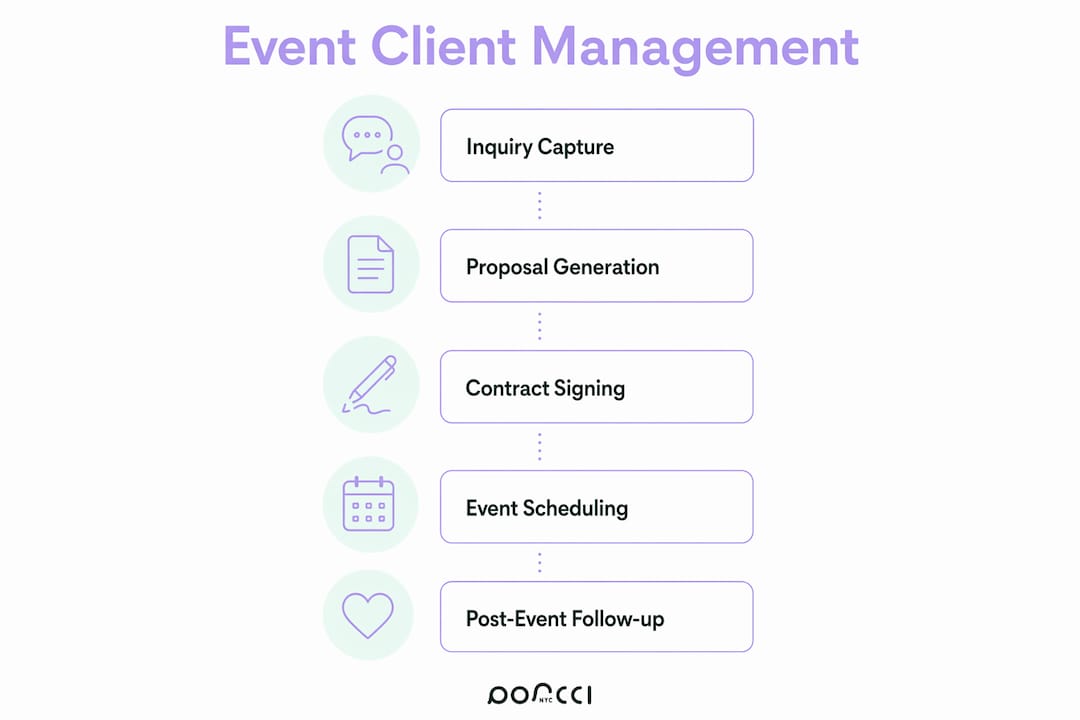
Automated workflows that connect inquiry capture, proposal generation, contract signing, and event scheduling eliminate manual data entry and prevent lost touchpoints. This integration creates a digital record of every client interaction and every event detail.
The impact is measurable. Automation reduces client management hours by about 40%. That time goes back into relationship building and event quality.
Pro Tip: Before choosing client management software, map your current workflow on paper. Identify where you lose time or drop client details. Then select a tool that solves those specific gaps, not the most feature-rich platform on the market.
Post-event follow-up is not a courtesy. It is a sales process. Planners who treat it as optional leave referrals and repeat bookings on the table. Timed follow-ups at three key intervals drive retention and referrals:
1. 48 hours after the event. Send a personal thank-you message. Ask one specific question about their experience.
2. Two weeks post-event. Check in on outcomes. For corporate clients, ask about ROI or team feedback. This positions you as a partner, not just a vendor.
3. 60 days post-event. Share a relevant industry trend or congratulate the client on a milestone. This touchpoint keeps you visible without being pushy.
Post-event relationship management treated as a strategic sales process with scheduled outreach and referral systems maximizes client lifetime value and lowers acquisition costs. Planners who build referral systems into their post-event workflow turn one client into five.
Strong planners act as internal team partners, sharing industry trends and celebrating client milestones between events. That behavior shifts the relationship from transactional to strategic. Clients who see you as a partner refer you without being asked. You can also check our event staffing tips for planners for more ways to build those long-term connections.
Effective event client management requires structured communication, specialized technology, and deliberate post-event engagement to convert single bookings into long-term client relationships.
| Point | Details |
|---|---|
| Speed drives conversions | Responding to leads within one hour increases booking conversions by 22%. |
| Tiered communication works | Use biweekly, weekly, and daily cadences based on how close the event date is. |
| Event CRMs outperform generic tools | Only event-specific CRMs convert closed deals into active operational workspaces. |
| Automation saves significant time | Integrated workflows reduce client management hours by about 40%. |
| Post-event follow-up builds revenue | Timed outreach at 48 hours, two weeks, and 60 days drives referrals and repeat bookings. |
The biggest mistake planners make is treating client management as a checklist. They complete the kickoff meeting, send the proposal, and then go quiet until something needs a decision. Clients fill that silence with anxiety, and anxious clients become difficult clients.
We have seen planners invest in client management software and immediately over-automate. They set up email sequences that fire on a schedule but say nothing specific to the client’s event. The client receives a message that feels like a newsletter, not a conversation. Trust drops fast.
The shift that actually works is treating every client like they are your only client during every touchpoint. That does not mean more hours. It means more intention. A 60-second personalized voice note after a site visit does more for trust than three automated emails. Technology should handle the logistics. You should handle the relationship.
The planners we respect most have also made the mental shift from vendor to partner. They do not wait for the client to call with a problem. They call first with a solution or a relevant insight. That proactive posture is what turns a single corporate event into an annual contract. It is not a personality trait. It is a practice you can build into your workflow starting today.
— PORCCI
Reliable suppliers reduce the operational pressure that makes client management harder. When your entertainment and equipment are confirmed and professionally managed, you spend less time chasing logistics and more time building client relationships. Porcci NYC provides DJ services across NYC and New Jersey that planners trust for corporate events, weddings, and private parties. We also offer karaoke machine rentals and photo booth packages that give clients a memorable guest experience. Every booking includes setup, delivery, and breakdown so your event planning checklist stays clean. Request a quote at porccinyc.com/quote and let us handle the entertainment side while you focus on your clients.
Event client management is the process of organizing all client interactions from the first inquiry through post-event follow-up. It covers communication, contracts, logistics, and retention in one coordinated system.
High-performing planners use biweekly check-ins three or more months before an event, weekly updates in the final two months, and daily contact during event week. This structure keeps clients informed without creating communication overload.
A regular CRM tracks leads and closes deals. An event CRM converts those closed deals into active workspaces with timelines, vendor lists, and budgets, covering the full event lifecycle rather than stopping at the signed contract.
Send a personal message within 48 hours, a ROI or outcome check-in at two weeks, and a strategic touchpoint at 60 days. This three-stage sequence drives referrals and increases the chance of repeat bookings.
Responding to a new inquiry within one hour increases booking conversions by 22%. Fast response signals professionalism and reduces the chance the client contacts another planner before hearing from you.
Discover what is event client management and learn how it enhances client relationships, reduces errors, and boosts repeat bookings for planners.
TL;DR:
• Event client management involves handling all client interactions throughout their event journey to build lasting relationships. Effective communication, specialized tools, and timely follow-up turn one-time clients into repeat customers and generate referrals.
Event client management is the organized process of handling all client interactions, workflows, and communications from the first inquiry through post-event follow-up. The industry term for this practice is client lifecycle management, and it covers every touchpoint a planner has with a client. Done well, it reduces planning errors, builds trust, and turns one-time clients into repeat bookings. At Porcci NYC, we see planners struggle most when they treat client management as a series of tasks rather than a continuous relationship process. This article breaks down the core components, communication strategies, and technology tools that make event client management work.
Event client management is the full system a planner uses to move a client from inquiry to event completion and beyond. It covers lead capture, proposals, contracts, logistics coordination, day-of execution, and post-event retention. The goal is not just to run a good event. The goal is to build a client relationship that generates referrals and repeat business.
The lifecycle breaks into six clear stages:
1. Inquiry and lead qualification. Capture the lead, assess fit, and respond fast. Responding within one hour increases booking conversions by 22%. Speed signals professionalism before the first meeting.
2. Proposal, contract, and deposit. Send a detailed proposal, collect a signed contract, and secure a deposit. This stage sets financial and legal expectations clearly.
3. Kickoff meeting and intake. Run a 45–60 minute kickoff meeting and collect a completed intake form within 48 hours. This meeting is where you define communication rules and decision-making authority.
4. Vendor sourcing and timeline coordination. Source vendors, build the event timeline, and confirm logistics. Keep the client informed without overwhelming them with every detail.
5. Day-of execution. Run operational check-ins and manage real-time changes. The client should feel confident, not involved in every micro-decision.
6. Post-event close-out. Send final invoices, request reviews, and distribute satisfaction surveys. This stage is also the start of your retention strategy.
Each stage requires a different communication approach and a different set of tools. Planners who treat all six stages the same way lose clients at the handoff points.
Strong client communication follows a tiered cadence based on how close the event is. High-performing planners use biweekly check-ins when an event is three or more months away, weekly updates in the final two months, daily contact during event week, and a 48-hour wrap-up after the event. This structure prevents clients from feeling ignored or overwhelmed.
Every update message should cover three things:
• What changed since the last communication
• What the client needs to decide or approve
• What happens next and by when
Clients scan updates for exactly these three points. A structured message prevents misunderstandings and delayed decisions that push timelines back.
Setting decision-making authority in the kickoff meeting is equally critical. Explicit boundaries upfront prevent scope creep and reduce client frustration from misaligned expectations. Clients who know what they control and what you control make faster decisions.
Pro Tip: Personalize every automated message with at least one detail specific to the client’s event. Over-automating communications without personal event context damages client trust faster than infrequent updates.
Generic CRMs are built to close deals. Event client management requires more. Event CRMs convert closed deals into active event workspaces that hold timelines, vendor lists, and budgets in one place. That distinction matters because a planner’s work does not end at the signed contract. It starts there.
The table below shows how generic CRM features compare to event-specific CRM capabilities:
| Feature category | Generic CRM | Event CRM |
|---|---|---|
| Lead capture and tracking | Yes | Yes |
| Proposal and contract tools | Limited | Built-in |
| Live event workspace | No | Yes |
| Vendor and timeline management | No | Yes |
| Post-event follow-up automation | Basic | Structured sequences |
Automated workflows that connect inquiry capture, proposal generation, contract signing, and event scheduling eliminate manual data entry and prevent lost touchpoints. This integration creates a digital record of every client interaction and every event detail.
The impact is measurable. Automation reduces client management hours by about 40%. That time goes back into relationship building and event quality.
Pro Tip: Before choosing client management software, map your current workflow on paper. Identify where you lose time or drop client details. Then select a tool that solves those specific gaps, not the most feature-rich platform on the market.
Post-event follow-up is not a courtesy. It is a sales process. Planners who treat it as optional leave referrals and repeat bookings on the table. Timed follow-ups at three key intervals drive retention and referrals:
1. 48 hours after the event. Send a personal thank-you message. Ask one specific question about their experience.
2. Two weeks post-event. Check in on outcomes. For corporate clients, ask about ROI or team feedback. This positions you as a partner, not just a vendor.
3. 60 days post-event. Share a relevant industry trend or congratulate the client on a milestone. This touchpoint keeps you visible without being pushy.
Post-event relationship management treated as a strategic sales process with scheduled outreach and referral systems maximizes client lifetime value and lowers acquisition costs. Planners who build referral systems into their post-event workflow turn one client into five.
Strong planners act as internal team partners, sharing industry trends and celebrating client milestones between events. That behavior shifts the relationship from transactional to strategic. Clients who see you as a partner refer you without being asked. You can also check our event staffing tips for planners for more ways to build those long-term connections.
Effective event client management requires structured communication, specialized technology, and deliberate post-event engagement to convert single bookings into long-term client relationships.
| Point | Details |
|---|---|
| Speed drives conversions | Responding to leads within one hour increases booking conversions by 22%. |
| Tiered communication works | Use biweekly, weekly, and daily cadences based on how close the event date is. |
| Event CRMs outperform generic tools | Only event-specific CRMs convert closed deals into active operational workspaces. |
| Automation saves significant time | Integrated workflows reduce client management hours by about 40%. |
| Post-event follow-up builds revenue | Timed outreach at 48 hours, two weeks, and 60 days drives referrals and repeat bookings. |
The biggest mistake planners make is treating client management as a checklist. They complete the kickoff meeting, send the proposal, and then go quiet until something needs a decision. Clients fill that silence with anxiety, and anxious clients become difficult clients.
We have seen planners invest in client management software and immediately over-automate. They set up email sequences that fire on a schedule but say nothing specific to the client’s event. The client receives a message that feels like a newsletter, not a conversation. Trust drops fast.
The shift that actually works is treating every client like they are your only client during every touchpoint. That does not mean more hours. It means more intention. A 60-second personalized voice note after a site visit does more for trust than three automated emails. Technology should handle the logistics. You should handle the relationship.
The planners we respect most have also made the mental shift from vendor to partner. They do not wait for the client to call with a problem. They call first with a solution or a relevant insight. That proactive posture is what turns a single corporate event into an annual contract. It is not a personality trait. It is a practice you can build into your workflow starting today.
— PORCCI
Reliable suppliers reduce the operational pressure that makes client management harder. When your entertainment and equipment are confirmed and professionally managed, you spend less time chasing logistics and more time building client relationships. Porcci NYC provides DJ services across NYC and New Jersey that planners trust for corporate events, weddings, and private parties. We also offer karaoke machine rentals and photo booth packages that give clients a memorable guest experience. Every booking includes setup, delivery, and breakdown so your event planning checklist stays clean. Request a quote at porccinyc.com/quote and let us handle the entertainment side while you focus on your clients.
Event client management is the process of organizing all client interactions from the first inquiry through post-event follow-up. It covers communication, contracts, logistics, and retention in one coordinated system.
High-performing planners use biweekly check-ins three or more months before an event, weekly updates in the final two months, and daily contact during event week. This structure keeps clients informed without creating communication overload.
A regular CRM tracks leads and closes deals. An event CRM converts those closed deals into active workspaces with timelines, vendor lists, and budgets, covering the full event lifecycle rather than stopping at the signed contract.
Send a personal message within 48 hours, a ROI or outcome check-in at two weeks, and a strategic touchpoint at 60 days. This three-stage sequence drives referrals and increases the chance of repeat bookings.
Responding to a new inquiry within one hour increases booking conversions by 22%. Fast response signals professionalism and reduces the chance the client contacts another planner before hearing from you.