Discover why nightlife venues need event staff to enhance safety, ensure compliance, and boost operational efficiency for unforgettable events.
TL;DR:
• Nightlife venues require trained staff to ensure safety, liquor compliance, and smooth guest flow during events. Proper staffing reduces legal risks, improves operational efficiency, and enhances guest experience, especially at larger or alcohol-serving gatherings. Booking qualified staff two to eight weeks early with a detailed briefing and supervisor oversight is essential for a successful event.
Nightlife venues need trained event staff to keep guests safe, stay liquor-compliant, and protect the night’s revenue and reputation. Without the right people in the right roles, a single incident — an overserved guest, a blocked exit, a delayed bar open — can cost more than the entire event earned.
The three highest-impact reasons to staff your event:
• Safety and liquor compliance: Properly licensed and certified staff are required at rented or public venues where alcohol is sold or served to remain compliant with local regulations.
• Crowd control and guest flow: Trained door hosts and floor managers keep lines moving, prevent bottlenecks, and protect the atmosphere guests paid for.
• Operational efficiency: Staff who handle setup, AV coordination, and breakdown reduce vendor confusion and protect your timeline from the first hour to the last.
TL;DR: Book trained staff with a supervisor at least two to eight weeks out, confirm certifications and insurance before the event, and run a 20-minute arrival briefing with a one-page site map.
• Why do nightlife venues need event staff?
• What are the key event staff roles at a nightlife event?
• How many staff do you need for your event size?
• How does trained staff reduce legal risk in NYC and New Jersey?
• What operational benefits do event staff deliver beyond safety?
• How should you hire event staff for a nightlife venue?
• What does event staffing cost, and how do you calculate ROI?
• Your pre-event staffing checklist for NYC & NJ venues
• The staffing mistake most NYC planners make
• Porcci NYC staffing packages for NYC and New Jersey events
• Useful sources and resources
• FAQ
The short answer: risk travels fast in a crowded room. A venue without trained staff is one spilled drink away from a liability claim, a liquor-license review, or a guest injury that ends up in a lawsuit.
• Safety and incident management: Trained staff recognize medical emergencies, de-escalate conflicts before they escalate, and know the venue’s emergency exits. Equipment failures — a tripped breaker, a mic that cuts out — get handled without pulling the host off the floor.
• Liquor-law compliance: In New York and New Jersey, serving alcohol to a minor or a visibly intoxicated guest carries real penalties for the venue, not just the bartender. Certified staff who understand responsible-service protocols are your first line of defense.
• Crowd control: A packed room with no floor manager is a revenue leak. Guests who can’t find a seat, can’t reach the bar, or wait 20 minutes for a drink leave early and don’t come back.
• Guest experience: First impressions are set at the door. A professional host who greets guests by name and directs them confidently sets the tone for everything that follows.
• Operational efficiency: Benefits of having event staff extend well beyond service — they include coordinating vendors, managing AV cues, and keeping the run-of-show on track so the host can focus on guests.
Pro Tip: Brief your staff on the venue’s specific liquor policy before doors open, not during the event. A five-minute policy walkthrough at the start of the arrival briefing prevents the most common compliance mistakes.
Each role covers a specific slice of the guest experience. Mixing them up — or skipping one — creates gaps that guests notice immediately.

| Role | Core Responsibilities | When It’s Essential |
|---|---|---|
| Door host / greeter | Guest list management, ID checks, first impressions | Every ticketed or age-restricted event |
| Security | Crowd control, incident response, exit management | Events with late-night alcohol service |
| Bartender | Drink service, responsible-service enforcement, line management | Any event serving alcohol |
| Barback | Restocking, ice, glassware, bar cleanliness | Events with high bar volume or multiple stations |
| Server / waitstaff | Table service, food delivery, guest needs | Plated dinners, VIP sections, seated receptions |
| Floor / banquet manager | Vendor liaison, run-of-show enforcement, staff supervision | All events over 75 guests |
| AV / tech staff | Sound, lighting cues, mic management, equipment troubleshooting | Events with live music, DJ, or presentations |
| Coat check | Guest belongings, crowd flow at entry | Winter events, upscale venues |
| MC | Program flow, announcements, energy management | Weddings, corporate events, ticketed shows |
Professional bartenders do more than pour drinks: they manage crowd flow, enforce responsible service, and create consistent beverage experiences — certifications like TIPS matter here.
At smaller events (under 75 guests), a bartender can double as a barback and a greeter can cover light floor duties. Once you cross 150 guests or add a late-night alcohol component, separate those roles. Add a floor supervisor any time you have three or more staff on the floor — someone needs to own the run-of-show in real time.
Staffing ratios are a starting point, not a formula. Layout complexity raises staffing needs faster than guest counts alone — a multi-room venue with a rooftop bar needs more staff than a single-floor space with the same headcount.
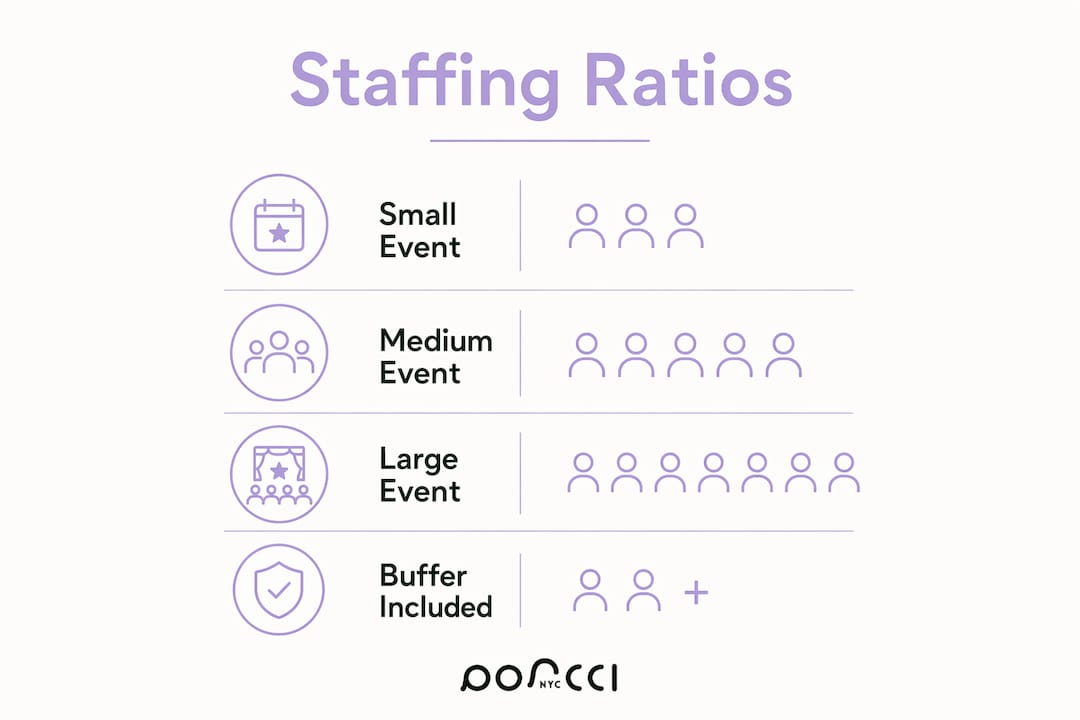
| Event Type | Server Ratio | Bartender Ratio | Door/Host |
|---|---|---|---|
| Plated dinner | 1 per 10 guests | 1 per 75 guests | 1–2 |
| Cocktail reception | 1 per 25 guests | 1 per 75 guests | 1–2 |
| Club / dance night | — | 1 per 75 guests | 2+ with security |
| VIP / private party | 1 per 8 guests | — | 1 dedicated |
Two quick examples:
A 150-guest cocktail reception needs roughly 6 servers, 2 bartenders, and 1 door host — plus a floor supervisor. A 500-guest club night needs 12–13 servers, 5–7 bartenders, 2–3 door hosts, and at least 2 security staff — with a head supervisor overseeing the floor.
Pro Tip: Always build in a 10–15% staffing buffer for no-shows, and confirm a backup contact with your provider 48 hours before the event. For events longer than four hours, schedule staff in overlapping shifts with clear handover points.
New York and New Jersey both hold venues — not just individual servers — responsible for alcohol-related incidents. A venue that cannot demonstrate trained, certified staff and documented protocols faces fines, license suspension, or civil liability.
What trained staff do to protect your venue:
• Check IDs at the door and at the bar, every time, regardless of apparent age
• Recognize signs of intoxication and cut off service before an incident occurs
• Document incidents in writing, on-site, with timestamps
• Know the venue’s emergency escalation path (who calls 911, who manages the crowd)
Documents to request from any staffing provider:
1. Certificate of general liability insurance
2. Proof of worker coverage (equivalent to workers’ compensation)
3. TIPS certification or equivalent responsible-service training records for bartenders
4. Background check confirmation for security staff
5. Supervisor contact information and on-site chain of command
Hiring insured, certified staff gives venues documented proof that reasonable care was taken — which matters significantly in any post-incident review.
This article is general information, not legal advice. Confirm current permit requirements and liquor regulations with the New York State Liquor Authority, the New Jersey Division of Alcoholic Beverage Control, or a qualified attorney for your specific event.
The most expensive staffing mistakes are invisible: a bar that opens 30 minutes late, an AV system that nobody tested, a caterer who can’t find the loading dock. Trained staff prevent all three.
• A floor manager who walks the venue two hours before doors open catches the dead mic, the missing extension cord, and the bar setup that’s blocking the fire exit.
• AV and lighting coordination handled by dedicated tech staff means the DJ’s first song hits on cue and the speeches aren’t competing with feedback.
• Staff who manage vendor arrivals — caterer, rental drop-off, live performers — keep the loading dock clear and the timeline intact.
When staff handle setup and breakdown, the venue owner isn’t chasing down a rental company at midnight. That alone is worth the line item. Nightclub equipment rental packages that bundle staff with gear eliminate the vendor finger-pointing that derails so many events.
Pro Tip: Include setup, delivery, and breakdown windows in your staffing contract. A provider who shows up only for service hours leaves you managing the before and after alone.
Three models exist: in-house staff, temp agencies, and full-service providers. Each has a real trade-off.
In-house staff give you consistency and venue knowledge, but scheduling, training, and backup coverage fall entirely on you. Temp agencies offer flexibility and a larger pool, but vetting certifications and confirming insurance requires extra legwork. Full-service providers like Porcci NYC handle staffing, equipment, and coordination in one package — reducing the number of vendors you’re managing on event day.
Must-ask questions before booking any provider:
1. Do you carry general liability insurance? Can you provide a certificate?
2. Are your bartenders TIPS-certified or equivalent?
3. Who is the on-site supervisor, and what is their direct contact number?
4. What is your backup plan if a staff member cancels day-of?
5. Have your staff worked events in NYC or New Jersey before?
6. What is your cancellation and rebooking policy?
Book staff 2–8 weeks before your event and confirm the final headcount 48 hours out. Share the run-of-show and a site map at least one week in advance. For vendor coordination questions — particularly around live performers — the same vetting discipline applies: asking the right questions before hiring any vendor protects your timeline and your budget.
Labor typically represents 60–70% of the hospitality event’s labor budget, with additional costs for uniforms making up 5–10%, and training and on-site supervision accounting for 10–15%. Those numbers sound significant until you compare them to the cost of a single liquor-violation fine, a guest injury claim, or a night where the bar ran dry at 10 PM because nobody was managing inventory.
Common cost line items:
• Hourly rates per staff role (bartenders and security typically run higher than servers)
• Supervisor or floor manager fee (often a flat rate per event)
• Travel or delivery fees for staff arriving from outside the venue’s borough
• Uniform or dress-code compliance costs
• Pre-event training time if the provider charges for it
A simple ROI frame: if a properly staffed bar serves guests 20% faster, bar revenue per hour increases proportionally. Add avoided fines and reduced post-event cleanup costs, and the staffing line item pays for itself before the last guest leaves.
1. Confirm staff headcount, roles, and supervisor name in writing.
2. Request and file the certificate of insurance and certification records.
3. Share the run-of-show, site map, and vendor contact list at least one week out.
4. Confirm staff arrival window (typically 60–90 minutes before doors open).
5. Run a 20-minute arrival briefing covering site map, emergency protocols, and escalation contacts.
6. Confirm the incident documentation process with the floor supervisor.
7. Verify backup staffing protocol and day-of cancellation contact.
8. Confirm payment terms, overtime policy, and end-of-night breakdown window.
Nightlife venues that skip trained event staff trade short-term savings for long-term liability, lost revenue, and guest experiences that don’t bring anyone back.
| Point | Details |
|---|---|
| Risk and compliance | Licensed, certified staff are required at alcohol-serving events and are your primary defense against fines and license issues. |
| Guest experience and revenue | Proper staffing ratios (e.g., 1 server per 10 guests for plated dinners) directly protect bar throughput and guest satisfaction. |
| Hiring and briefing | Book staff 2–8 weeks out, confirm insurance and certifications, and run a 20-minute on-arrival briefing with a site map. |
| Operational efficiency | Bundling setup, delivery, and breakdown into your staffing contract eliminates vendor gaps and protects your timeline. |
| Porcci NYC | Porcci NYC offers staffing packages that include setup, delivery, and breakdown across NYC boroughs and key New Jersey areas. |
Most planners focus on headcount and forget about the briefing. We’ve seen well-staffed events fall apart because twelve people showed up with no shared understanding of the run-of-show, the emergency exit locations, or who to call when the AV system cut out. The staff were qualified. The briefing was missing.
The 20-minute arrival briefing is the single most underused tool in event management. A one-page sheet covering the site map, key vendor contacts, emergency protocols, and staff expectations costs nothing to prepare and prevents the kind of on-site confusion that no amount of experience can fix in the moment.
The other thing planners underestimate: the floor supervisor role. Many providers will send staff without a dedicated supervisor unless you ask for one explicitly. For any event over 75 guests in NYC or New Jersey, that supervisor is not optional. They own the run-of-show in real time, redeploy staff when the cocktail hour runs long, and make the call when something goes sideways. That’s the role that protects your event when the plan meets reality.
Porcci NYC builds staffing into its event packages from the start — not as an afterthought. Every package includes setup, delivery, and breakdown, so you’re not coordinating three separate vendors on event day. Staff are matched to your event type, whether that’s a private party in Brooklyn, a corporate night in Hoboken, or a wedding reception in Manhattan.
Service covers all five NYC boroughs and major New Jersey areas including Newark, Jersey City, and surrounding regions. Packages can include floor supervisors, bartenders, AV staff, and door hosts alongside DJ services and entertainment rentals — all confirmed in one booking. Request a quote directly at porccinyc.com/quote to get a staffing plan built around your guest count, venue layout, and event type.
• Why You Should Hire Event Staff — practical overview of compliance, insurance, and booking timelines
• Event Staffing Guide: Roles, Ratios, and Briefing — staffing ratios, briefing templates, and shift planning
• Hospitality Staffing for Corporate Events — budget percentages, ratio baselines, and supervisor guidance
• How to Staff a Bar Event Right in NYC and NJ — Porcci NYC’s bar-specific staffing guide
• Corporate Event Staffing Workflow — run-of-show templates and workflow checklists
• New York State Liquor Authority (sla.ny.gov) — current permit requirements and responsible-service rules for NYC events
• New Jersey Division of Alcoholic Beverage Control (nj.gov/oag/abc) — NJ-specific liquor permit and compliance guidance
Trained event staff manage safety, liquor compliance, and guest flow simultaneously — tasks that cannot be reliably handled by venue owners or guests. A single unmanaged incident can result in fines, license suspension, or civil liability.
Bartenders serving alcohol at events in New York and New Jersey should hold TIPS certification or an equivalent responsible-service credential, which demonstrates training in recognizing intoxication and refusing service appropriately.
Book staff 2–8 weeks before your event and confirm the final headcount 48 hours out. Last-minute bookings increase the risk of unvetted staff and missing certifications.
A standard cocktail reception runs approximately 1 server per 25 guests and 1 bartender per 75 guests, with at least one door host. Add a floor supervisor for any event over 75 guests.
Yes. Porcci NYC offers staffing packages that include setup, delivery, and breakdown across NYC boroughs and key New Jersey areas, with options to add floor supervisors, bartenders, and AV staff alongside entertainment rentals.
Discover why nightlife venues need event staff to enhance safety, ensure compliance, and boost operational efficiency for unforgettable events.
TL;DR:
• Nightlife venues require trained staff to ensure safety, liquor compliance, and smooth guest flow during events. Proper staffing reduces legal risks, improves operational efficiency, and enhances guest experience, especially at larger or alcohol-serving gatherings. Booking qualified staff two to eight weeks early with a detailed briefing and supervisor oversight is essential for a successful event.
Nightlife venues need trained event staff to keep guests safe, stay liquor-compliant, and protect the night’s revenue and reputation. Without the right people in the right roles, a single incident — an overserved guest, a blocked exit, a delayed bar open — can cost more than the entire event earned.
The three highest-impact reasons to staff your event:
• Safety and liquor compliance: Properly licensed and certified staff are required at rented or public venues where alcohol is sold or served to remain compliant with local regulations.
• Crowd control and guest flow: Trained door hosts and floor managers keep lines moving, prevent bottlenecks, and protect the atmosphere guests paid for.
• Operational efficiency: Staff who handle setup, AV coordination, and breakdown reduce vendor confusion and protect your timeline from the first hour to the last.
TL;DR: Book trained staff with a supervisor at least two to eight weeks out, confirm certifications and insurance before the event, and run a 20-minute arrival briefing with a one-page site map.
• Why do nightlife venues need event staff?
• What are the key event staff roles at a nightlife event?
• How many staff do you need for your event size?
• How does trained staff reduce legal risk in NYC and New Jersey?
• What operational benefits do event staff deliver beyond safety?
• How should you hire event staff for a nightlife venue?
• What does event staffing cost, and how do you calculate ROI?
• Your pre-event staffing checklist for NYC & NJ venues
• The staffing mistake most NYC planners make
• Porcci NYC staffing packages for NYC and New Jersey events
• Useful sources and resources
• FAQ
The short answer: risk travels fast in a crowded room. A venue without trained staff is one spilled drink away from a liability claim, a liquor-license review, or a guest injury that ends up in a lawsuit.
• Safety and incident management: Trained staff recognize medical emergencies, de-escalate conflicts before they escalate, and know the venue’s emergency exits. Equipment failures — a tripped breaker, a mic that cuts out — get handled without pulling the host off the floor.
• Liquor-law compliance: In New York and New Jersey, serving alcohol to a minor or a visibly intoxicated guest carries real penalties for the venue, not just the bartender. Certified staff who understand responsible-service protocols are your first line of defense.
• Crowd control: A packed room with no floor manager is a revenue leak. Guests who can’t find a seat, can’t reach the bar, or wait 20 minutes for a drink leave early and don’t come back.
• Guest experience: First impressions are set at the door. A professional host who greets guests by name and directs them confidently sets the tone for everything that follows.
• Operational efficiency: Benefits of having event staff extend well beyond service — they include coordinating vendors, managing AV cues, and keeping the run-of-show on track so the host can focus on guests.
Pro Tip: Brief your staff on the venue’s specific liquor policy before doors open, not during the event. A five-minute policy walkthrough at the start of the arrival briefing prevents the most common compliance mistakes.
Each role covers a specific slice of the guest experience. Mixing them up — or skipping one — creates gaps that guests notice immediately.
| Role | Core Responsibilities | When It’s Essential |
|---|---|---|
| Door host / greeter | Guest list management, ID checks, first impressions | Every ticketed or age-restricted event |
| Security | Crowd control, incident response, exit management | Events with late-night alcohol service |
| Bartender | Drink service, responsible-service enforcement, line management | Any event serving alcohol |
| Barback | Restocking, ice, glassware, bar cleanliness | Events with high bar volume or multiple stations |
| Server / waitstaff | Table service, food delivery, guest needs | Plated dinners, VIP sections, seated receptions |
| Floor / banquet manager | Vendor liaison, run-of-show enforcement, staff supervision | All events over 75 guests |
| AV / tech staff | Sound, lighting cues, mic management, equipment troubleshooting | Events with live music, DJ, or presentations |
| Coat check | Guest belongings, crowd flow at entry | Winter events, upscale venues |
| MC | Program flow, announcements, energy management | Weddings, corporate events, ticketed shows |
Professional bartenders do more than pour drinks: they manage crowd flow, enforce responsible service, and create consistent beverage experiences — certifications like TIPS matter here.
At smaller events (under 75 guests), a bartender can double as a barback and a greeter can cover light floor duties. Once you cross 150 guests or add a late-night alcohol component, separate those roles. Add a floor supervisor any time you have three or more staff on the floor — someone needs to own the run-of-show in real time.
Staffing ratios are a starting point, not a formula. Layout complexity raises staffing needs faster than guest counts alone — a multi-room venue with a rooftop bar needs more staff than a single-floor space with the same headcount.
| Event Type | Server Ratio | Bartender Ratio | Door/Host |
|---|---|---|---|
| Plated dinner | 1 per 10 guests | 1 per 75 guests | 1–2 |
| Cocktail reception | 1 per 25 guests | 1 per 75 guests | 1–2 |
| Club / dance night | — | 1 per 75 guests | 2+ with security |
| VIP / private party | 1 per 8 guests | — | 1 dedicated |
Two quick examples:
A 150-guest cocktail reception needs roughly 6 servers, 2 bartenders, and 1 door host — plus a floor supervisor. A 500-guest club night needs 12–13 servers, 5–7 bartenders, 2–3 door hosts, and at least 2 security staff — with a head supervisor overseeing the floor.
Pro Tip: Always build in a 10–15% staffing buffer for no-shows, and confirm a backup contact with your provider 48 hours before the event. For events longer than four hours, schedule staff in overlapping shifts with clear handover points.
New York and New Jersey both hold venues — not just individual servers — responsible for alcohol-related incidents. A venue that cannot demonstrate trained, certified staff and documented protocols faces fines, license suspension, or civil liability.
What trained staff do to protect your venue:
• Check IDs at the door and at the bar, every time, regardless of apparent age
• Recognize signs of intoxication and cut off service before an incident occurs
• Document incidents in writing, on-site, with timestamps
• Know the venue’s emergency escalation path (who calls 911, who manages the crowd)
Documents to request from any staffing provider:
1. Certificate of general liability insurance
2. Proof of worker coverage (equivalent to workers’ compensation)
3. TIPS certification or equivalent responsible-service training records for bartenders
4. Background check confirmation for security staff
5. Supervisor contact information and on-site chain of command
Hiring insured, certified staff gives venues documented proof that reasonable care was taken — which matters significantly in any post-incident review.
This article is general information, not legal advice. Confirm current permit requirements and liquor regulations with the New York State Liquor Authority, the New Jersey Division of Alcoholic Beverage Control, or a qualified attorney for your specific event.
The most expensive staffing mistakes are invisible: a bar that opens 30 minutes late, an AV system that nobody tested, a caterer who can’t find the loading dock. Trained staff prevent all three.
• A floor manager who walks the venue two hours before doors open catches the dead mic, the missing extension cord, and the bar setup that’s blocking the fire exit.
• AV and lighting coordination handled by dedicated tech staff means the DJ’s first song hits on cue and the speeches aren’t competing with feedback.
• Staff who manage vendor arrivals — caterer, rental drop-off, live performers — keep the loading dock clear and the timeline intact.
When staff handle setup and breakdown, the venue owner isn’t chasing down a rental company at midnight. That alone is worth the line item. Nightclub equipment rental packages that bundle staff with gear eliminate the vendor finger-pointing that derails so many events.
Pro Tip: Include setup, delivery, and breakdown windows in your staffing contract. A provider who shows up only for service hours leaves you managing the before and after alone.
Three models exist: in-house staff, temp agencies, and full-service providers. Each has a real trade-off.
In-house staff give you consistency and venue knowledge, but scheduling, training, and backup coverage fall entirely on you. Temp agencies offer flexibility and a larger pool, but vetting certifications and confirming insurance requires extra legwork. Full-service providers like Porcci NYC handle staffing, equipment, and coordination in one package — reducing the number of vendors you’re managing on event day.
Must-ask questions before booking any provider:
1. Do you carry general liability insurance? Can you provide a certificate?
2. Are your bartenders TIPS-certified or equivalent?
3. Who is the on-site supervisor, and what is their direct contact number?
4. What is your backup plan if a staff member cancels day-of?
5. Have your staff worked events in NYC or New Jersey before?
6. What is your cancellation and rebooking policy?
Book staff 2–8 weeks before your event and confirm the final headcount 48 hours out. Share the run-of-show and a site map at least one week in advance. For vendor coordination questions — particularly around live performers — the same vetting discipline applies: asking the right questions before hiring any vendor protects your timeline and your budget.
Labor typically represents 60–70% of the hospitality event’s labor budget, with additional costs for uniforms making up 5–10%, and training and on-site supervision accounting for 10–15%. Those numbers sound significant until you compare them to the cost of a single liquor-violation fine, a guest injury claim, or a night where the bar ran dry at 10 PM because nobody was managing inventory.
Common cost line items:
• Hourly rates per staff role (bartenders and security typically run higher than servers)
• Supervisor or floor manager fee (often a flat rate per event)
• Travel or delivery fees for staff arriving from outside the venue’s borough
• Uniform or dress-code compliance costs
• Pre-event training time if the provider charges for it
A simple ROI frame: if a properly staffed bar serves guests 20% faster, bar revenue per hour increases proportionally. Add avoided fines and reduced post-event cleanup costs, and the staffing line item pays for itself before the last guest leaves.
1. Confirm staff headcount, roles, and supervisor name in writing.
2. Request and file the certificate of insurance and certification records.
3. Share the run-of-show, site map, and vendor contact list at least one week out.
4. Confirm staff arrival window (typically 60–90 minutes before doors open).
5. Run a 20-minute arrival briefing covering site map, emergency protocols, and escalation contacts.
6. Confirm the incident documentation process with the floor supervisor.
7. Verify backup staffing protocol and day-of cancellation contact.
8. Confirm payment terms, overtime policy, and end-of-night breakdown window.
Nightlife venues that skip trained event staff trade short-term savings for long-term liability, lost revenue, and guest experiences that don’t bring anyone back.
| Point | Details |
|---|---|
| Risk and compliance | Licensed, certified staff are required at alcohol-serving events and are your primary defense against fines and license issues. |
| Guest experience and revenue | Proper staffing ratios (e.g., 1 server per 10 guests for plated dinners) directly protect bar throughput and guest satisfaction. |
| Hiring and briefing | Book staff 2–8 weeks out, confirm insurance and certifications, and run a 20-minute on-arrival briefing with a site map. |
| Operational efficiency | Bundling setup, delivery, and breakdown into your staffing contract eliminates vendor gaps and protects your timeline. |
| Porcci NYC | Porcci NYC offers staffing packages that include setup, delivery, and breakdown across NYC boroughs and key New Jersey areas. |
Most planners focus on headcount and forget about the briefing. We’ve seen well-staffed events fall apart because twelve people showed up with no shared understanding of the run-of-show, the emergency exit locations, or who to call when the AV system cut out. The staff were qualified. The briefing was missing.
The 20-minute arrival briefing is the single most underused tool in event management. A one-page sheet covering the site map, key vendor contacts, emergency protocols, and staff expectations costs nothing to prepare and prevents the kind of on-site confusion that no amount of experience can fix in the moment.
The other thing planners underestimate: the floor supervisor role. Many providers will send staff without a dedicated supervisor unless you ask for one explicitly. For any event over 75 guests in NYC or New Jersey, that supervisor is not optional. They own the run-of-show in real time, redeploy staff when the cocktail hour runs long, and make the call when something goes sideways. That’s the role that protects your event when the plan meets reality.
Porcci NYC builds staffing into its event packages from the start — not as an afterthought. Every package includes setup, delivery, and breakdown, so you’re not coordinating three separate vendors on event day. Staff are matched to your event type, whether that’s a private party in Brooklyn, a corporate night in Hoboken, or a wedding reception in Manhattan.
Service covers all five NYC boroughs and major New Jersey areas including Newark, Jersey City, and surrounding regions. Packages can include floor supervisors, bartenders, AV staff, and door hosts alongside DJ services and entertainment rentals — all confirmed in one booking. Request a quote directly at porccinyc.com/quote to get a staffing plan built around your guest count, venue layout, and event type.
• Why You Should Hire Event Staff — practical overview of compliance, insurance, and booking timelines
• Event Staffing Guide: Roles, Ratios, and Briefing — staffing ratios, briefing templates, and shift planning
• Hospitality Staffing for Corporate Events — budget percentages, ratio baselines, and supervisor guidance
• How to Staff a Bar Event Right in NYC and NJ — Porcci NYC’s bar-specific staffing guide
• Corporate Event Staffing Workflow — run-of-show templates and workflow checklists
• New York State Liquor Authority (sla.ny.gov) — current permit requirements and responsible-service rules for NYC events
• New Jersey Division of Alcoholic Beverage Control (nj.gov/oag/abc) — NJ-specific liquor permit and compliance guidance
Trained event staff manage safety, liquor compliance, and guest flow simultaneously — tasks that cannot be reliably handled by venue owners or guests. A single unmanaged incident can result in fines, license suspension, or civil liability.
Bartenders serving alcohol at events in New York and New Jersey should hold TIPS certification or an equivalent responsible-service credential, which demonstrates training in recognizing intoxication and refusing service appropriately.
Book staff 2–8 weeks before your event and confirm the final headcount 48 hours out. Last-minute bookings increase the risk of unvetted staff and missing certifications.
A standard cocktail reception runs approximately 1 server per 25 guests and 1 bartender per 75 guests, with at least one door host. Add a floor supervisor for any event over 75 guests.
Yes. Porcci NYC offers staffing packages that include setup, delivery, and breakdown across NYC boroughs and key New Jersey areas, with options to add floor supervisors, bartenders, and AV staff alongside entertainment rentals.