Discover why event professionals matter in NYC and NJ. Learn how their expertise transforms challenges into successful, unforgettable events.
TL;DR:
• Professional event planning in NYC and NJ relies on structured workflows, vendor management, and contingency strategies to ensure seamless execution.
• These practices help manage rising complexity, tight schedules, and high guest expectations, delivering better results and peace of mind.
Planning an event in New York City or New Jersey feels straightforward until it isn’t. You book a venue, line up a few vendors, and suddenly you’re managing a dozen moving parts with no clear system to hold them together. Research confirms that event professionals deliver better outcomes when speed, fragmentation, and sourcing complexity increase. That reality hits especially hard in metro areas where venue schedules are tight, vendor pools are competitive, and guest expectations run high. This article breaks down exactly why professionals consistently outperform DIY approaches and how to decide what your event needs.
• Event planning today: Rising challenges and complexity
• What professionals do differently: Structured operations for flawless events
• DIY vs. professional planners: Which approach fits your event?
• Delivering measurable results: How professionals enhance the guest and organizer experience
• Why the invisible work makes all the difference
• Bringing professional power to your next NYC or NJ event
| Point | Details |
|---|---|
| Professionals reduce complexity | Event pros streamline planning, managing multiple vendors and tight timelines with proven systems. |
| Operational expertise lowers risk | Expert planners use schedules, vendor management, and contingency plans to solve problems before guests notice. |
| Not all events require a pro | Small, simple events can go DIY, but public or complex gatherings benefit greatly from professional management. |
| Measurable outcomes improve experience | With professionals, events run smoother, stress is lower, and guests enjoy a better experience. |
The NYC and NJ event landscape has shifted dramatically over the past few years. Venues are booking faster, vendor availability is shrinking for popular dates, and guests expect production quality that rivals what they see at larger public events. Coordinating a wedding in Manhattan, a corporate gala in Jersey City, or a private birthday party in Brooklyn now requires a level of logistical precision that catches many first-time organizers off guard.
Consider the sourcing challenge alone. Finding a quality sound system, a reliable photo booth vendor, event lighting, catering, and staffing that all align on the same date in the same borough takes significant time and negotiation skill. When one vendor falls through, the whole plan can unravel. This fragmentation is one of the biggest pain points modern organizers face.
“Professionals deliver better outcomes in high-pressure settings with structured workflows and centralized approaches, especially when sourcing complexity and time pressure increase.”
Key challenges event organizers face in NYC and NJ right now:
• Venue scarcity: Popular dates fill up six to twelve months in advance, leaving limited backup options
• Vendor fragmentation: Multiple separate vendors for AV, catering, decor, and entertainment create coordination gaps
• Time pressure: Corporate clients and social hosts often operate on compressed timelines of four to eight weeks
• Budget volatility: Last-minute sourcing in NYC frequently means paying premium rates for standard services
• Permit and compliance complexity: Public events in NYC require permits, noise restrictions, and insurance documentation
Working with one-stop event providers has emerged as a practical solution to this fragmentation. When your AV, lighting, photo booth, and entertainment all come from one coordinated source, you eliminate the single biggest risk factor in event planning: miscommunication between vendors.
Having understood the rising complexity, let’s break down what sets professionals apart from DIY or informal approaches. The answer comes down to systems, not just talent.
A professional event operation runs on documented workflows. According to a practical methodology for event operations, the most effective approach is operations-first planning built on four pillars: communication systems, vendor management, contingency reserves, and a detailed run-of-show document.
Here is how each pillar functions in practice:
1. Run-of-show document: A minute-by-minute timeline that assigns specific tasks to specific team members. Every vendor knows their cue, every setup window is pre-calculated, and the MC knows exactly when to transition between segments.
2. Vendor confirmation checkpoints: Professionals contact each vendor at 30 days, 7 days, and 48 hours before the event. This catches cancellations, equipment issues, and delivery conflicts before they become emergencies.
3. Contingency reserves: Budget and time buffers built into the plan. If a speaker fails or a lighting rig needs replacement, a professional team has a solution ready. DIY planners often have neither the budget buffer nor the vendor relationships to recover quickly.
4. Backward scheduling: Starting from the event end time and building backward ensures every setup task, vendor arrival, and rehearsal fits within the actual available window.
| Operational element | DIY approach | Professional approach |
|---|---|---|
| Run-of-show document | Informal notes or memory | Detailed, role-assigned timeline |
| Vendor communication | Ad hoc emails or calls | Structured checkpoint system |
| Contingency planning | Rarely formalized | Built-in budget and time buffers |
| Day-of coordination | Organizer does everything | Dedicated operations staff |
| Equipment troubleshooting | Google and hope | Technician on-site |
Understanding how rental companies and event planners collaborate gives organizers a clearer picture of why professional teams execute so consistently. Familiarity with event planning terms also helps when reviewing contracts and production documents, so you know exactly what you’re agreeing to.
Pro Tip: Ask any vendor you interview for their run-of-show template or event day checklist. A professional who can’t produce one is likely winging it, and that’s a real risk in a high-stakes NYC or NJ event environment.
Now that you’ve seen how the pros operate, it’s helpful to know when their expertise truly makes the biggest difference. The answer depends on four key variables: event size, complexity, timeline, and your existing vendor relationships.
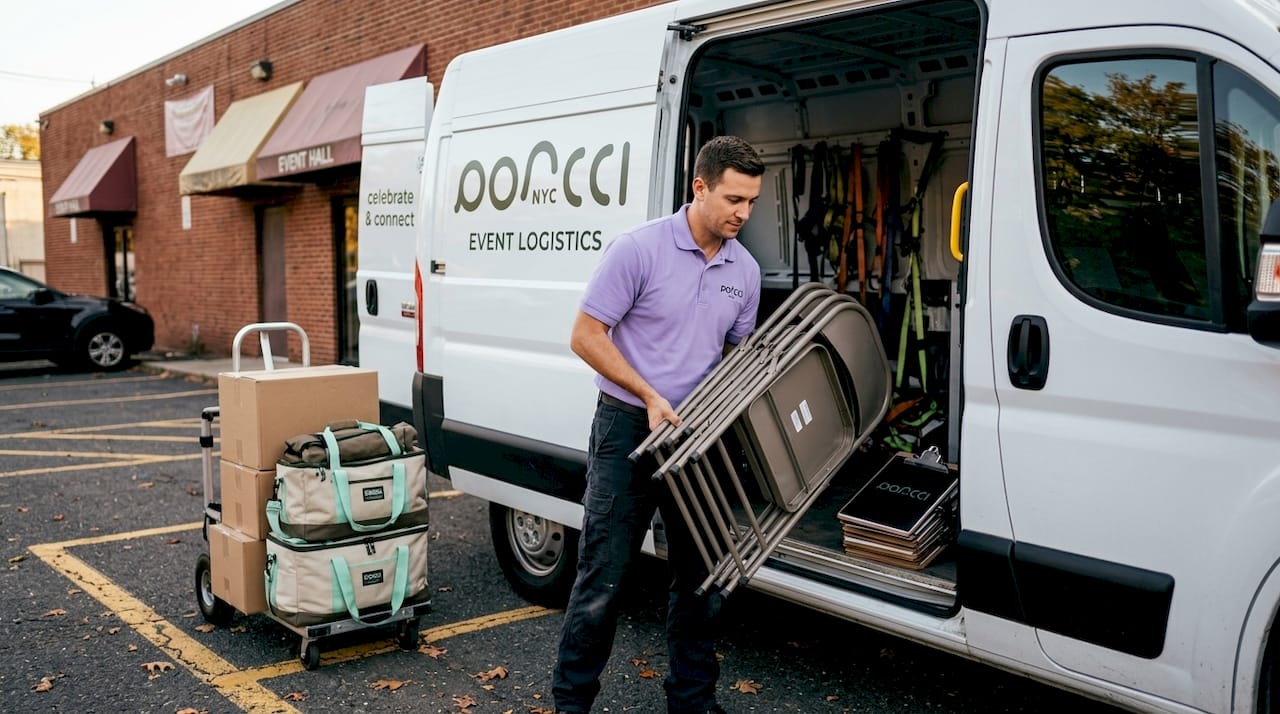
Planner value scales with event complexity. For a small backyard birthday with twenty guests and a single caterer, a DIY approach is completely reasonable. For a 200-person wedding in a Manhattan venue with eight vendors, a photo booth, a DJ, custom lighting, and a catering team, the operational complexity makes professional support essentially mandatory.
| Factor | DIY suitable | Professional recommended |
|---|---|---|
| Guest count | Under 50 | 50 and above |
| Vendor count | 1 to 2 | 3 or more |
| Event type | Casual or private | Corporate, wedding, public-facing |
| Planning timeline | 3 or more months | Under 8 weeks |
| Budget sensitivity | Flexible | Fixed or publicly accountable |
Key considerations when making this decision:
• Budget: Professional planners add cost upfront, but they often negotiate better vendor rates and prevent costly mistakes that DIY organizers miss
• Time availability: Organizing a NYC or NJ event professionally takes 60 to 100 hours of preparation. Do you have that time alongside your job and personal obligations?
• Local vendor access: Professionals have established relationships that give them access to preferred pricing and backup options when primary vendors fall through
• Risk tolerance: Corporate events and weddings have zero margin for major failures. The reputational and financial stakes make professional support worthwhile
The value of outsourcing event rentals goes beyond convenience. When your equipment arrives pre-tested, set up by technicians, and supported by an on-call team, your focus stays on your guests rather than troubleshooting cables. For AV-heavy events, reviewing a solid event sound system guide helps you understand what questions to ask and what quality benchmarks to hold vendors to.
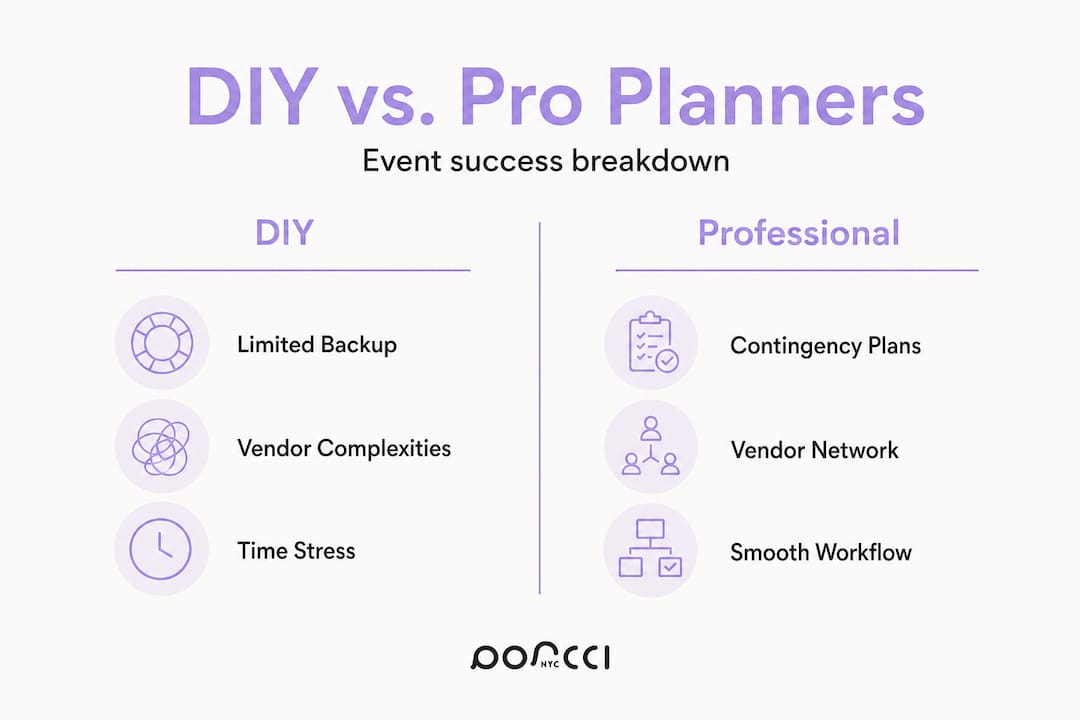
Understanding when to hire a pro leads naturally to seeing what they actually deliver. The outcomes aren’t just aesthetic. They’re operational and measurable.
A strong professional approach shows up in specific results: events that start on time, transitions between segments that feel natural rather than awkward, and problems that get resolved before guests ever notice them. Here is what that looks like in practice:
1. On-time execution: A detailed run-of-show means setup crews, caterers, and entertainment all arrive and complete their tasks within assigned windows. Events that start late create a domino effect of stress for organizers and frustration for guests.
2. Seamless transitions: Moving from cocktail hour to dinner to dancing feels effortless when a professional coordinator is directing each handoff with clear signals to all vendors.
3. Rapid problem resolution: A professional team in NYC once handled a complete venue power failure during a corporate gala by having a backup generator protocol already in place. Guests experienced a five-minute pause. Without that contingency plan, the event would have ended early.
4. Organizer peace of mind: When you aren’t fielding questions from the DJ, the caterer, and the photo booth operator simultaneously, you’re actually present at your own event.
Pro Tip: Build a clear point-of-contact hierarchy into your event plan. Every vendor should know exactly one person to call with questions on event day. This single change eliminates 80% of the coordination chaos that derails DIY events.
Investing in professional event lighting is one area where the visible impact on guest experience is immediate. Lighting shifts the entire perceived quality of a venue. Guests who might not consciously notice the lighting will absolutely feel the difference between flat fluorescent overhead lights and a warm, professionally designed ambiance.
Here’s something we’ve observed time and again in NYC and NJ event environments: the work that gets praised is never the work that matters most. Guests compliment the floral arrangements. They photograph the photo booth. They talk about the DJ. Almost nobody mentions that the event started exactly on time, that a microphone issue was resolved in ninety seconds, or that the catering team moved from appetizers to dinner without a single awkward gap.
That invisible work is where professional planners earn their fee. Creativity and decor create the atmosphere. Operations keep the event alive. When operationally measurable practices reduce risk in urban settings, the guest experience elevates without guests ever knowing why.
We’ve seen it happen in New Jersey ballrooms where a vendor no-showed and a replacement was confirmed within forty-five minutes because of pre-built contingency relationships. We’ve seen it in Manhattan lofts where a noise ordinance complaint was preempted because the team had already coordinated with building management and had the sound levels documented. These aren’t glamorous stories. They’re boring. And that’s exactly the point.
A lot of organizers get seduced by the creative side of event planning and underestimate the logistical infrastructure that holds it all together. When you hire professionals who are serious about their event production approach, you’re not paying for a prettier room. You’re paying for the quiet systems that make sure the room works.
If operational excellence and guest satisfaction matter to you, we’re here to help make your next event seamless. At Porcci NYC, we offer a full range of professional rental and entertainment services designed specifically for events across New York City and New Jersey. From NYC photo booth rentals that keep your guests engaged all night to fully configured NYC AV equipment rentals that arrive tested and ready, we handle the logistics so your focus stays on the experience. Every package includes delivery, setup, and breakdown. Ready to plan something memorable? Get a custom quote and let’s build the right setup for your event.
A professional planner streamlines vendor coordination, builds contingency plans, and manages the day-of schedule so your event runs smoothly without constant intervention from you. Research confirms that structured workflows and centralized approaches consistently deliver better outcomes in high-pressure, multi-vendor events.
For small, simple gatherings with one or two vendors and flexible timelines, in-house planning can work fine. However, planners add significantly more value for public, corporate, or complex multi-vendor events where the cost of mistakes is high.
They build detailed run-of-show documents, establish vendor confirmation checkpoints, and maintain contingency reserves so that when something goes wrong, a solution is already in motion before guests notice anything.
For events with high stakes, large guest counts, or tight timelines, the investment pays for itself in avoided mistakes and reduced stress. Professional planners are most valuable when event complexity and public visibility increase the cost of failure.
Discover why event professionals matter in NYC and NJ. Learn how their expertise transforms challenges into successful, unforgettable events.
TL;DR:
• Professional event planning in NYC and NJ relies on structured workflows, vendor management, and contingency strategies to ensure seamless execution.
• These practices help manage rising complexity, tight schedules, and high guest expectations, delivering better results and peace of mind.
Planning an event in New York City or New Jersey feels straightforward until it isn’t. You book a venue, line up a few vendors, and suddenly you’re managing a dozen moving parts with no clear system to hold them together. Research confirms that event professionals deliver better outcomes when speed, fragmentation, and sourcing complexity increase. That reality hits especially hard in metro areas where venue schedules are tight, vendor pools are competitive, and guest expectations run high. This article breaks down exactly why professionals consistently outperform DIY approaches and how to decide what your event needs.
• Event planning today: Rising challenges and complexity
• What professionals do differently: Structured operations for flawless events
• DIY vs. professional planners: Which approach fits your event?
• Delivering measurable results: How professionals enhance the guest and organizer experience
• Why the invisible work makes all the difference
• Bringing professional power to your next NYC or NJ event
| Point | Details |
|---|---|
| Professionals reduce complexity | Event pros streamline planning, managing multiple vendors and tight timelines with proven systems. |
| Operational expertise lowers risk | Expert planners use schedules, vendor management, and contingency plans to solve problems before guests notice. |
| Not all events require a pro | Small, simple events can go DIY, but public or complex gatherings benefit greatly from professional management. |
| Measurable outcomes improve experience | With professionals, events run smoother, stress is lower, and guests enjoy a better experience. |
The NYC and NJ event landscape has shifted dramatically over the past few years. Venues are booking faster, vendor availability is shrinking for popular dates, and guests expect production quality that rivals what they see at larger public events. Coordinating a wedding in Manhattan, a corporate gala in Jersey City, or a private birthday party in Brooklyn now requires a level of logistical precision that catches many first-time organizers off guard.
Consider the sourcing challenge alone. Finding a quality sound system, a reliable photo booth vendor, event lighting, catering, and staffing that all align on the same date in the same borough takes significant time and negotiation skill. When one vendor falls through, the whole plan can unravel. This fragmentation is one of the biggest pain points modern organizers face.
“Professionals deliver better outcomes in high-pressure settings with structured workflows and centralized approaches, especially when sourcing complexity and time pressure increase.”
Key challenges event organizers face in NYC and NJ right now:
• Venue scarcity: Popular dates fill up six to twelve months in advance, leaving limited backup options
• Vendor fragmentation: Multiple separate vendors for AV, catering, decor, and entertainment create coordination gaps
• Time pressure: Corporate clients and social hosts often operate on compressed timelines of four to eight weeks
• Budget volatility: Last-minute sourcing in NYC frequently means paying premium rates for standard services
• Permit and compliance complexity: Public events in NYC require permits, noise restrictions, and insurance documentation
Working with one-stop event providers has emerged as a practical solution to this fragmentation. When your AV, lighting, photo booth, and entertainment all come from one coordinated source, you eliminate the single biggest risk factor in event planning: miscommunication between vendors.
Having understood the rising complexity, let’s break down what sets professionals apart from DIY or informal approaches. The answer comes down to systems, not just talent.
A professional event operation runs on documented workflows. According to a practical methodology for event operations, the most effective approach is operations-first planning built on four pillars: communication systems, vendor management, contingency reserves, and a detailed run-of-show document.
Here is how each pillar functions in practice:
1. Run-of-show document: A minute-by-minute timeline that assigns specific tasks to specific team members. Every vendor knows their cue, every setup window is pre-calculated, and the MC knows exactly when to transition between segments.
2. Vendor confirmation checkpoints: Professionals contact each vendor at 30 days, 7 days, and 48 hours before the event. This catches cancellations, equipment issues, and delivery conflicts before they become emergencies.
3. Contingency reserves: Budget and time buffers built into the plan. If a speaker fails or a lighting rig needs replacement, a professional team has a solution ready. DIY planners often have neither the budget buffer nor the vendor relationships to recover quickly.
4. Backward scheduling: Starting from the event end time and building backward ensures every setup task, vendor arrival, and rehearsal fits within the actual available window.
| Operational element | DIY approach | Professional approach |
|---|---|---|
| Run-of-show document | Informal notes or memory | Detailed, role-assigned timeline |
| Vendor communication | Ad hoc emails or calls | Structured checkpoint system |
| Contingency planning | Rarely formalized | Built-in budget and time buffers |
| Day-of coordination | Organizer does everything | Dedicated operations staff |
| Equipment troubleshooting | Google and hope | Technician on-site |
Understanding how rental companies and event planners collaborate gives organizers a clearer picture of why professional teams execute so consistently. Familiarity with event planning terms also helps when reviewing contracts and production documents, so you know exactly what you’re agreeing to.
Pro Tip: Ask any vendor you interview for their run-of-show template or event day checklist. A professional who can’t produce one is likely winging it, and that’s a real risk in a high-stakes NYC or NJ event environment.
Now that you’ve seen how the pros operate, it’s helpful to know when their expertise truly makes the biggest difference. The answer depends on four key variables: event size, complexity, timeline, and your existing vendor relationships.
Planner value scales with event complexity. For a small backyard birthday with twenty guests and a single caterer, a DIY approach is completely reasonable. For a 200-person wedding in a Manhattan venue with eight vendors, a photo booth, a DJ, custom lighting, and a catering team, the operational complexity makes professional support essentially mandatory.
| Factor | DIY suitable | Professional recommended |
|---|---|---|
| Guest count | Under 50 | 50 and above |
| Vendor count | 1 to 2 | 3 or more |
| Event type | Casual or private | Corporate, wedding, public-facing |
| Planning timeline | 3 or more months | Under 8 weeks |
| Budget sensitivity | Flexible | Fixed or publicly accountable |
Key considerations when making this decision:
• Budget: Professional planners add cost upfront, but they often negotiate better vendor rates and prevent costly mistakes that DIY organizers miss
• Time availability: Organizing a NYC or NJ event professionally takes 60 to 100 hours of preparation. Do you have that time alongside your job and personal obligations?
• Local vendor access: Professionals have established relationships that give them access to preferred pricing and backup options when primary vendors fall through
• Risk tolerance: Corporate events and weddings have zero margin for major failures. The reputational and financial stakes make professional support worthwhile
The value of outsourcing event rentals goes beyond convenience. When your equipment arrives pre-tested, set up by technicians, and supported by an on-call team, your focus stays on your guests rather than troubleshooting cables. For AV-heavy events, reviewing a solid event sound system guide helps you understand what questions to ask and what quality benchmarks to hold vendors to.
Understanding when to hire a pro leads naturally to seeing what they actually deliver. The outcomes aren’t just aesthetic. They’re operational and measurable.
A strong professional approach shows up in specific results: events that start on time, transitions between segments that feel natural rather than awkward, and problems that get resolved before guests ever notice them. Here is what that looks like in practice:
1. On-time execution: A detailed run-of-show means setup crews, caterers, and entertainment all arrive and complete their tasks within assigned windows. Events that start late create a domino effect of stress for organizers and frustration for guests.
2. Seamless transitions: Moving from cocktail hour to dinner to dancing feels effortless when a professional coordinator is directing each handoff with clear signals to all vendors.
3. Rapid problem resolution: A professional team in NYC once handled a complete venue power failure during a corporate gala by having a backup generator protocol already in place. Guests experienced a five-minute pause. Without that contingency plan, the event would have ended early.
4. Organizer peace of mind: When you aren’t fielding questions from the DJ, the caterer, and the photo booth operator simultaneously, you’re actually present at your own event.
Pro Tip: Build a clear point-of-contact hierarchy into your event plan. Every vendor should know exactly one person to call with questions on event day. This single change eliminates 80% of the coordination chaos that derails DIY events.
Investing in professional event lighting is one area where the visible impact on guest experience is immediate. Lighting shifts the entire perceived quality of a venue. Guests who might not consciously notice the lighting will absolutely feel the difference between flat fluorescent overhead lights and a warm, professionally designed ambiance.
Here’s something we’ve observed time and again in NYC and NJ event environments: the work that gets praised is never the work that matters most. Guests compliment the floral arrangements. They photograph the photo booth. They talk about the DJ. Almost nobody mentions that the event started exactly on time, that a microphone issue was resolved in ninety seconds, or that the catering team moved from appetizers to dinner without a single awkward gap.
That invisible work is where professional planners earn their fee. Creativity and decor create the atmosphere. Operations keep the event alive. When operationally measurable practices reduce risk in urban settings, the guest experience elevates without guests ever knowing why.
We’ve seen it happen in New Jersey ballrooms where a vendor no-showed and a replacement was confirmed within forty-five minutes because of pre-built contingency relationships. We’ve seen it in Manhattan lofts where a noise ordinance complaint was preempted because the team had already coordinated with building management and had the sound levels documented. These aren’t glamorous stories. They’re boring. And that’s exactly the point.
A lot of organizers get seduced by the creative side of event planning and underestimate the logistical infrastructure that holds it all together. When you hire professionals who are serious about their event production approach, you’re not paying for a prettier room. You’re paying for the quiet systems that make sure the room works.
If operational excellence and guest satisfaction matter to you, we’re here to help make your next event seamless. At Porcci NYC, we offer a full range of professional rental and entertainment services designed specifically for events across New York City and New Jersey. From NYC photo booth rentals that keep your guests engaged all night to fully configured NYC AV equipment rentals that arrive tested and ready, we handle the logistics so your focus stays on the experience. Every package includes delivery, setup, and breakdown. Ready to plan something memorable? Get a custom quote and let’s build the right setup for your event.
A professional planner streamlines vendor coordination, builds contingency plans, and manages the day-of schedule so your event runs smoothly without constant intervention from you. Research confirms that structured workflows and centralized approaches consistently deliver better outcomes in high-pressure, multi-vendor events.
For small, simple gatherings with one or two vendors and flexible timelines, in-house planning can work fine. However, planners add significantly more value for public, corporate, or complex multi-vendor events where the cost of mistakes is high.
They build detailed run-of-show documents, establish vendor confirmation checkpoints, and maintain contingency reserves so that when something goes wrong, a solution is already in motion before guests notice anything.
For events with high stakes, large guest counts, or tight timelines, the investment pays for itself in avoided mistakes and reduced stress. Professional planners are most valuable when event complexity and public visibility increase the cost of failure.